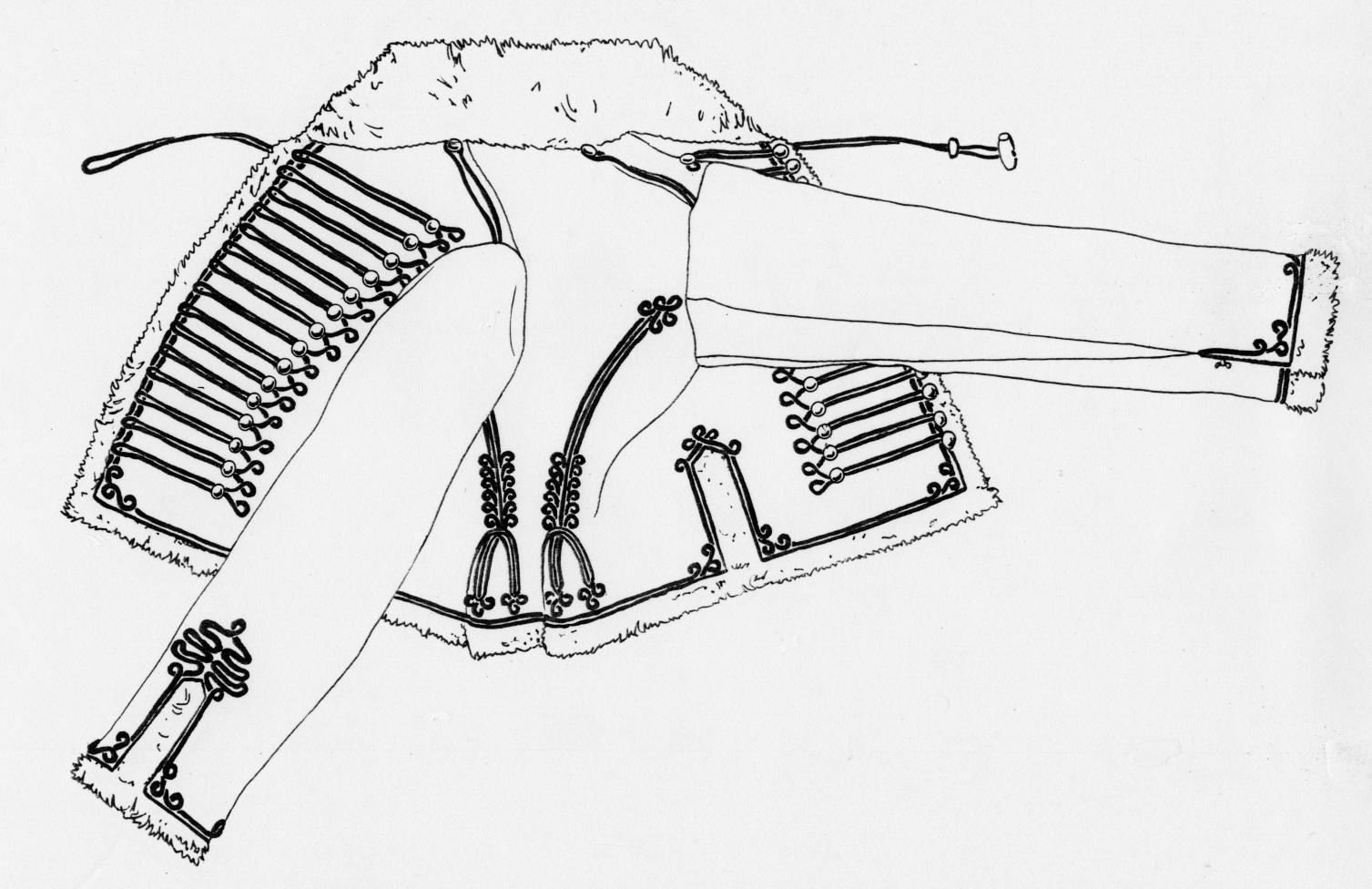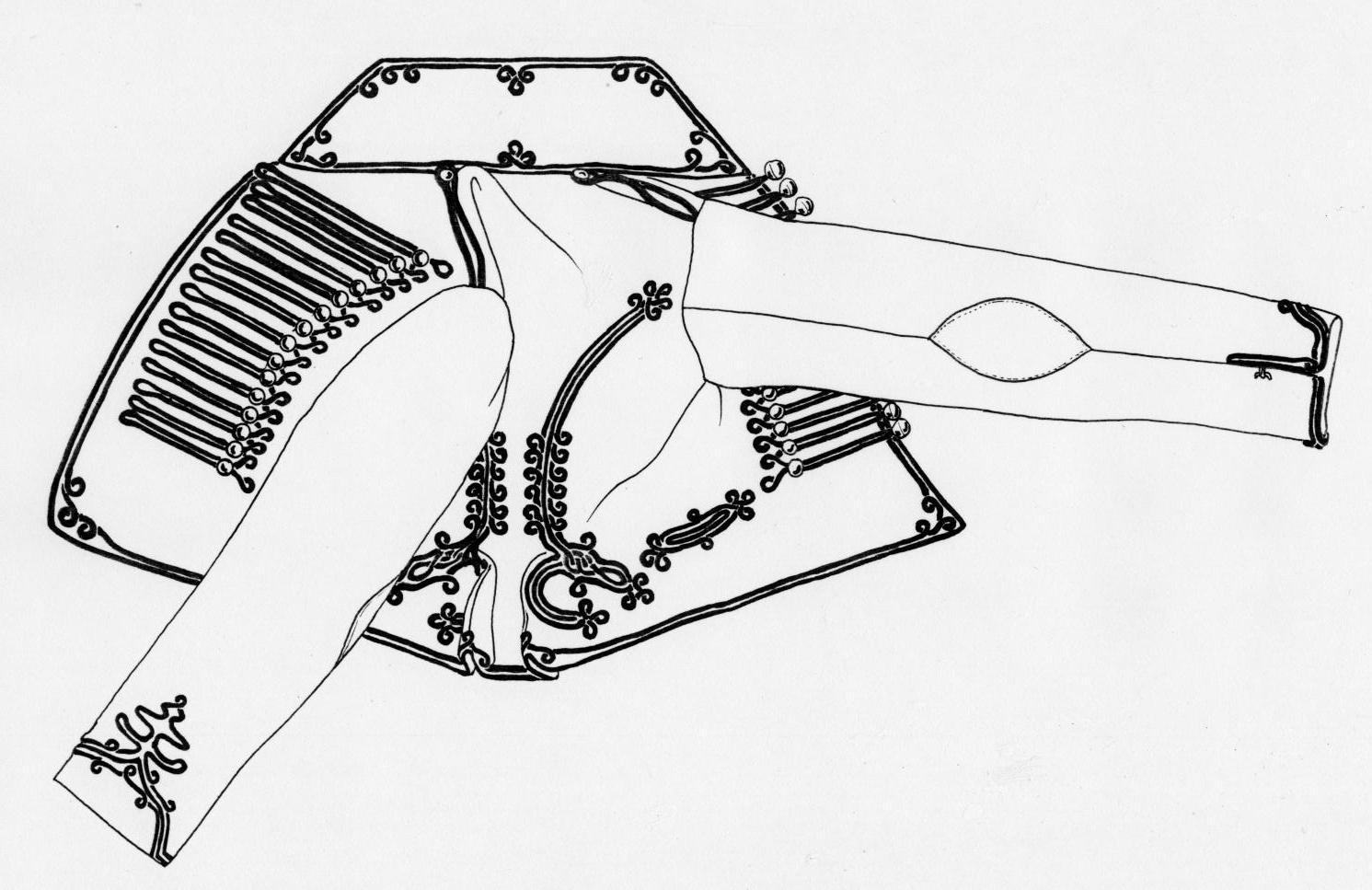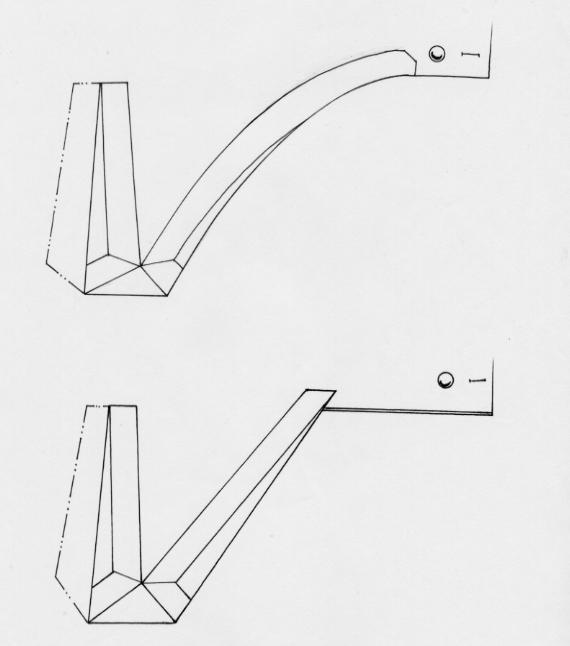
HISTORICAL DESCRIPTION
OF THE CLOTHING AND
ARMS OF THE RUSSIAN ARMY
A.V. VISKOVATOV
Compiled by HIGHEST direction
Saint Petersburg, Military Typography Office, 1853
[TRANSLATED BY MARK CONRAD, 1998]
VOLUME 11
Cuirassiers, Dragoons, Horse-Jägers, Hussars,
Lancers, Gendarmes, and the Train
1801-1825
_________________
Changes in the clothing and armaments of Army Cavalry, from 1801 through 1825:
I. Cuirassier Regiments
II. Dragoon Regiments
III. Horse-Jäger Regiments
IV. Hussar Regiments
V. Lancer Regiments
VI. Gendarme Regiment
VII. Army Train
Notes to the Illustrations.
Notes.
__________________
1401. Privates. HIS MAJESTY’S Life-Cuirassier Regiment. 1802-1811.
1402. Private. HIS MAJESTY’S Life-Cuirassier Regiment. 1802-1811.
1403. Private. HIS MAJESTY’S Life-Cuirassier Regiment. 1802-1803.
1404. Noncommissioned Officer. HER MAJESTY’S Life-Cuirassier Regiment. 1802-1803.
1405. Trumpeter. Order Cuirassier Regiment. 1802-1803.
1406. Staff-Trumpeters. Yekaterinoslavl and Little Russia Cuirassier Regiments. 1802-1803.
1407. Kettledrummer. Glukhov Cuirassier Regiment. 1802-1803.
1408. Officer. HIS MAJESTY’S Life-Cuirassier Regiment. 1802-1803.
1409. General. HER MAJESTY’S Life-Cuirassier Regiment. 1802-1803.
1410. Officer. Order Cuirassier Regiment. 1802-1803.
1411. Officers. Yekaterinoslavl Cuirassier Regiment. 1802-1803.
1412. Officers. Little Russia and Glukhov Cuirassier Regiments. 1802-1803.
1413. Cuirassier helmets from 1803 to 1808.
1414. Noncommissioned Officer and Trumpeter. HIS MAJESTY’S Life-Cuirassier Regiment. 1803-1808.
1415. Officer. HER MAJESTY’S Life-Cuirassier Regiment. 1803-1811.
1416. Cuirassier helmet of the Order Regiment, established in 1808.
1417 Field-grade Officer. Order Cuirassier Regiment. 1808-1811.
1418. Company-grade Officers. HIS MAJESTY’S Life-Cuirassier Regiment and HER MAJESTY’S Life-Cuirassier Regiment. 1808-1811.
1419. Noncommissioned Officer. Astrakhan Cuirassier Regiment. 1812-1814.
1420. Company-grade Officer. Novgorod Cuirassier Regiment. 1812-1817.
1421. Cuirass. Established in 1812.
1422. Noncommissioned Officer and Private. Pskov Cuirassier Regiment. 1813-1814.
1423. Private. Starodub Cuirassier Regiment. 1813-1814.
1424. General. Yekaterinoslavl Cuirassier Regiment. 1813-1814.
1425. Field-grade Officer. Yekaterinoslavl Cuirassier Regiment. 1814.
1426. Company-grade Officer and Noncommissioned Officer. Order Cuirassier Regiment. 1814.
1427. Private. Glukhov Cuirassier Regiment. 1814-1825.
1428. Noncommissioned Officer. Yekaterinoslavl Cuirassier Regiment. 1818-1825.
1429. Company-grade Officer and Staff-Trumpeter. Little Russia Cuirassier Regiment. 1818-1825.
1430. Privates. Riga and Starodub Dragoon Regiments. 1802-1803.
1431. Private. Kharkov Dragoon Regiment. 1802-1803.
1432. Noncommissioned Officer. Tver Dragoon Regiment. 1802-1803.
1433. Fahnen -Junker. St.-Petersburg Dragoon Regiment. 1802-1803.
1434. Trumpeter. Smolensk Dragoon Regiment. 1802-1803.
1435. Staff-Trumpeter. Pskov Dragoon Regiment. 1802-1802.
1436. Kettledrummer. Vladimir Dragoon Regiment. 1802-1803.
1437. Officer. Taganrog Dragoon Regiment. 1802-1803.
1438. Officer. Orenburg Dragoon Regiment. 1802-1803.
1439. Company-grade Officer. Kazan and Irkutsk Dragoon Regiments. 1802-1803.
1440. Privates. Courland and Pereyaslavl Dragoon Regiments. 1803-1806.
1441. Private. Livonia Dragoon Regiment. 1803-1806.
1442. Private. Finland Dragoon Regiment. 1806-1808.
1443. Private. Tiraspol Dragoon Regiment. 1806-1808.
1444. Private. Nezhin Dragoon Regiment. 1806-1808.
1445. Private. Serpukhov Dragoon Regiment. 1806-1808.
1446. Field-grade Officer. Arzamas Dragoon Regiment. 1807-1811.
1447. Private. Serpukhov Dragoon Regiment. 1808-1811.
1448. Private. Taganrog Dragoon Regiment. 1811.
1449. Noncommissioned Officer. Vladimir Dragoon Regiment. 1811.
1450. Company-grade Officer. Borisoglebsk Dragoon Regiment. 1811.
1451. Company-grade Officer. Kinburn Dragoon Regiment. 1812-1814.
1452. Company-grade Officer. Kinburn Dragoon Regiment. 1814-1817.
1453. Noncommissioned Officer. St.-Petersburg Dragoon Regiment. 1817-1817.
1454. Helmet, Kiev Dragoon Regiment (with badge for distinction). 1814-1817.
1455. Private. Kargopol Dragoon Regiment. 1816-1817.
1456. Privates. Kazan, Narva, and Moscow Dragoon Regiments. 1816-1817.
1457. Noncommissioned Officers. Smolensk and Finland Dragoon Regiments. 1816-1817.
1458. Company-grade Officers. Ingermanland and Courland Dragoon Regiments. 1816-1817.
1459. Noncommissioned Officer. Nizhnii-Novgorod Dragoon Regiment. 1816-1817.
1460. Cartridge pouch for Dragoon Officers (established in 1817).
1461. Privates. Moscow and Kargopol Dragoon Regiments. 1817-1820.
1462. Privates. Kinburn and Little Russia Dragoon Regiments. 1817-1825.
1463. Noncommissioned Officer. Kazan Dragoon Regiment. 1817-1820.
1464. Privates. Riga, Tver, and Finland Dragoon Regiments. 1817-1825.
1465. Trumpeters. St.-Petersburg and Kharkov Dragoon Regiments. 1817.
1466. Trumpeter. Smolensk Dragoon Regiment. 1817.
1467. Staff-Trumpeter. Courland Dragoon Regiment. 1817.
1468. Company-grade Officer. Ingermanland Dragoon Regiment. 1817-1820.
1469. Field-grade Officers. Narva and Riga Dragoon Regiments. 1817-1820.
1470. Field-grade Officer. Mitau Dragoon Regiment. 1817-1825.
1471. Trumpeter. Mitau Dragoon Regiment. 1817-1825.
1472. Noncommissioned Officer. Mitau Dragoon Regiment. 1819-1825.
1473. Private. Mitau Dragoon Regiment. 1820.
1474. Privates. Livonia Horse-Jäger Regiment 1813-1814.
1475. Noncommissioned Officer. Pereyaslavl Horse-Jäger Regiment. 1813-1814.
1476. Noncommissioned Officer. Seversk Horse-Jäger Regiment. 1813-1814.
1477. Trumpeter. Dorpat Horse-Jäger Regiment. 1813-1814.
1478. Staff-Trumpeter. Tiraspol Horse-Jäger Regiment. 1813-1814.
1479. Company-grade Officers. Chernigov Horse-Jäger Regiment. 1813-1814.
1480. Field-grade Officer and Company-grade Officer. Arzamas and Nezhin Horse-Jäger Regiment. 1813-1814.
1481. Private and Company-grade Officer. Livonia Horse-Jäger Regiment. 1814.
1482. Horse-Jäger Shakos.
1483. Privates. Seversk, Chernigov, and Nezhin Horse-Jäger Regiments. 1816-1819.
1484. Private. Dorpat Horse-Jäger Regiment. 1816-1817.
1485. Noncommissioned Officers. Pereyaslavl and Livonia Horse-Jäger Regiments. 1816-1817.
1486. Field-grade Officer and Company-grade Officer. Arzamas and Tiraspol Horse-Jäger Regiments. 1816-1817.
1487. Company-grade Officer. Tiraspol Horse-Jäger Regiment. 1817-1825.
1488. Trumpeter. Livonia Horse-Jäger Regiment. 1817-1819.
1489. Horse-Jäger musket, confirmed in 1817.
1490. Private. Tiraspol Horse-Jäger Regiment. 1819-1820.
1491. Private. Mariupol Hussar Regiment. 1802-1803.
1492. Private. Mariupol Hussar Regiment. 1802-1803.
1493. Hussar Shako. 1802-1803.
1494. Noncommissioned Officer. Pavlograd Hussar Regiment. 1802-1803.
1495. Noncommissioned Officer. Aleksandriya Hussar Regiment. 1802-1803.
1496. Trumpeter. Sumy Hussar Regiment. 1802-1803.
1497. Staff-Trumpeter. Akhtyrka Hussar Regiment. 1802-1803.
1498. Officer. Yelisavetgrad Hussar Regiment 1802-1803.
1499. Officer. Olviopol Hussar Regiment. 1802-1803.
1500. Officer. Izyum Hussar Regiment. 1802-1803.
1501. Private and Trumpeter. Belorussia Hussar Regiment 1803-1809.
1502. Noncommissioned Officer's Shako. Belorussia Hussar Regiment. 1803-1809.
1503. Officer and Staff-Trumpeter. Odessa Hussar Regiment. 1803.
1504. Trumpeter. Aleksandriya Hussar Regiment. 1803-1809.
1505. Officer and Trumpeter. Grodno Hussar Regiment. 1806-1809.
1506. Private. Lubny Hussar Regiment. 1807-1809.
1507. Company-grade Officer. Lubny Hussar Regiment. 1808-1810.
1508. Private. Mariupol Hussar Regiment. 1809-1811.
1509. Privates. Pavlograd, Aleksandriya, and Sumy Hussar Regiments. 1809-1811.
1510. Noncommissioned Officers. Akhtyrka and Yelisavetgrad Hussar Regiments. 1808-1811.
1511. Trumpeter. Olviopol Hussar Regiment. 1809-1811.
1512. Staff-Trumpeters. Izyum and Belorussia Hussar Regiments. 1809-1811.
1513. Officers. Grodno and Izyum Hussar Regiments. 1809-1811.
1514. Officer and Privates. Grodno Hussar Regiment. 1812-1817.
1515. Officer and Noncommissioned Officer. Irkutsk Hussar Regiment. 1813-1817.
1516. Hussar shako (with badge for distinction). 1814.
1517. Field and Company-grade Officers. Olviopol Hussar Regiment. 1814.
1518. Company-grade Officer and Noncommissioned Officer. Aleksandriya Hussar Regiment. 1814-1819.
1519. Rifle. 1814-1825.
1520. Hussar shakos, established in 1817, with badge for distinction.
1521. Trumpeter. Grodno Hussar Regiment. 1817-1819.
1522. Officer and Private. Izyum Hussar Regiment. 1817-1819.
1523. Privates. Sumy and Grodno Hussar Regiments. 1820.
1524. Noncommissioned Officers. Grodno, Lubny, and Izyum Hussar Regiments. 1820.
1525. Trumpeters. Pavlograd and Yelisavetgrad Hussar Regiments. 1820.
1526. Staff-Trumpeter. Irkutsk Hussar Regiment. 1820.
1527. Officers. Akhtyrka and Aleksandriya Hussar Regiments. 1820.
1528. Field-grade Officers. Mariupol and The Prince of Orange's Hussar Regiments. 1820.
1529. Company-grade Officers. The Prince of Orange's Hussar Regiment. 1820-1825.
1530. Comrade and Ranker. Tatar-Lithuanian Regiment. 1801-1803.
1531. Officer. Tatar-Lithuanian Regiment. 1801-1803.
1532. Officer and Comrade. Polish Horse Regiment. 1801-1803.
1533. Shapka Headdresses. 1803-1808.
1534. Comrades. Tatar and Lithuanian Horse Regiments. 1803-1806.
1535. Privates. HIS HIGHNESS THE TSESAREVICH CONSTANTINE PAVLOVICH’S Lancer Regiment. 1803-1806.
1536. Noncommissioned Officer. HIS HIGHNESS THE TSESAREVICH CONSTANTINE PAVLOVICH’S Lancer Regiment. 1803-1806.
1537. Trumpeter and Staff-Trumpeter. HIS HIGHNESS THE TSESAREVICH CONSTANTINE PAVLOVICH’S Lancer Regiment. 1803-1806.
1538. Officer. HIS HIGHNESS THE TSESAREVICH CONSTANTINE PAVLOVICH’S Lancer Regiment. 1803-1806.
1539. Noncommissioned Officer. Polish Horse Regiment. 1805-1806.
1540. Privates. HIS HIGHNESS THE TSESAREVICH CONSTANTINE PAVLOVICH’S Lancer Regiment. 1806-1808.
1541. Noncommissioned Officer. HIS HIGHNESS THE TSESAREVICH CONSTANTINE PAVLOVICH’S Lancer Regiment. 1808 and 1809.
1542. Noncommissioned Officer. Polish Horse Regiment. 1808-1811.
1543. Trumpeter. Tatar Lancer Regiment. 1808-1811.
1544. Staff-Trumpeter. Lithuania Lancer Regiment. 1808-1811.
1545. Private and Field-grade Officer. Volhynia Lancer Regiment. 1808-1811.
1546. Officer's and Soldier's Shapka Headdresses. Tatar Lancer Regiment. 1808-1811.
1547. Privates. Chuguev Lancer Regiment. 1808-1811.
1548. Company-grade Officer of the Yamburg Lancer Regiment. Noncommissioned Officer of the Orenburg Lancer Regiment. 1812-1814.
1549. Trumpeter. Izyum Lancer Regiment. 1812-1814.
1550. Private and Staff-Trumpeter. Siberia Lancer Regiment. 1812-1814.
1551. Company-grade Officer. Vladimir Lancer Regiment. 1812-1814.
1552. Field-grade Officer and Private. Taganrog Lancer Regiment. 1812-1814.
1553. Private. Serpukhov Lancer Regiment. 1812-1814.
1554. Company-grade Officer and Private. Serpukhov Lancer Regiment. 1814-1818.
1555. Company-grade Officers. Serpukhov Lancer Regiment. 1815-1818.
1556. Private. 1st Bug Lancer Regiment. 1817 and 1818.
1557. Private and Noncommissioned Officer. 2nd Bug Lancer Regiment. 1817 and 1818.
1558. Trumpeter. 3rd Bug Lancer Regiment. 1817 and 1818.
1559. Private and Company-grade Officer. 4th Bug Lancer Regiment. 1817 and 1818.
1560. Private. Polish Lancer Regiment. 1818 and 1819.
1561. Noncommissioned Officer. Tatar Lancer Regiment. 1818 and 1819.
1562. Trumpeter. Lithuania Lancer Regiment. 1818 and 1819.
1563. Field-grade Officer. Volhynia Lancer Regiment. 1818 and 1819.
1564. Soldier's and Officer's Shapka Headdresses. Volhynia Lancer Regiment. 1818 and 1819.
1565. Private and Officer. 1st Ukraine Lancer Regiment. 1818 and 1819.
1566. Noncommissioned Officer. 2nd Ukraine Lancer Regiment. 1818 and 1819.
1567. Trumpeter and Private. 3rd Ukraine Lancer Regiment. 1818 and 1819.
1568. Field-grade Officer. 4th Ukraine Lancer Regiment. 1818 and 1819.
1569. Noncommissioned Officer. 4th Ukraine Lancer Regiment. 1819.
1570. Field-grade Officer and Private. Vladimir Lancer Regiment. 1819-1825.
1571. Noncommissioned Officer. Siberia Lancer Regiment. 1819-1825.
1572. Trumpeter. Orenburg Lancer Regiment. 1819-1820.
1573. Company-grade Officer. Yamburg Lancer Regiment. 1819-1825.
1574. Privates. Taganrog and Chuguev Lancer Regiments. 1819-1825.
1575. Staff-Trumpeters. Borisoglebsk and Taganrog Lancer Regiments. 1819-1825.
1576. Private. 1st Ukraine Lancer Regiment. 1819-1825.
1577. Noncommissioned Officers. 2nd, 3rd, and 4th Ukraine Lancer Regiments. 1819-1825.
1578. Noncommissioned Officers. 1st and 2nd Bug Lancer Regiments. 1819-1825.
1579. Company-grade Officers. 3rd and 4th Bug Lancer Regiments. 1819-1825.
1580. Privates. Polish Lancer Regiment. 1819-1825.
1581. Noncommissioned Officer. Tatar Lancer Regiment. 1819-1825.
1582. Trumpeter. Lithuania Lancer Regiment. 1819-1825.
1583. Field-grade Officer and Company-grade Officer. Volhynia Lancer Regiment. 1819-1825.
1584. Trumpeters. Volhynia Lancer Regiment. 1820-1825.
1585. Privates. Gendarme Regiment. 1815-1817.
1586. Noncommissioned Officer. Gendarme Regiment. 1815-1817.
1587. Trumpeter and Staff-Trumpeter. Gendarme Regiment. 1815-1817.
1588. Company-grade Officer. Gendarme Regiment. 1815-1817.
1589. Field-grade Officers. Gendarme Regiment. 1815-1817.
1590. Field-grade Officers. Gendarme Regiment. 1815-1825.
1591. Noncommissioned Officer and Company-grade Officer. Gendarme Regiment. 1817-1825.
1592. Private. Gendarme Regiment. 1817-1820.
1593. Noncommissioned Officer and Trumpeter. Gendarme Regiment. 1820-1825.
1594. Privates. Train Battalions. 1819 and 1820.
1595. Noncommissioned Officers. Train Battalions. 1819 and 1820.
1596. Company-grade Officers. Train Battalions. 1819 and 1820.
1597. Noncommissioned Officer and Company-grade Officer. Train Battalions. 1820-1825.
1598. Noncommissioned Officer. Lithuania Train Brigade. 1820-1825.
1599. Company-grade Officer. Train Battalions of the Grenadier Corps. 1821-1825.
1600. Company-grade Officer. Lithuania Train Brigade. 1822-1825.
1601. Noncommissioned Officer. 1st Battalion of the Lithuania Train Brigade. 1823-1825.
1602. Private and Company-grade Officer. 1st Battalion of the Lithuania Train Brigade. 1823-1825.
__________________
9 April 1801 — Lower ranks are ordered to cut off their curls [pukli] and have queues [kosy] only 7 inches [4 vershka] long, tying them midway down the collar (1).
9 August 1801— The cuirasses [kirasy] in Cuirassier regiments are withdrawn (2).
27 February 1802— In place of their previous gloves with gauntlets [perchatki s kragenami], officers of Cuirassier regiments are to have short gloves without gauntlets, of the pattern used at this time by infantry officers (3).
17 March 1802— Confirmation is given to the regulations for the cut, trim, and pattern of Cuirassier uniforms, for combatant as well as for noncombatant ranks (4).
30 April 1802— Confirmation is given to a new table of uniforms, accouterments, and weapons of Cuirassier regiments. Based on this table and the previously mentioned regulations, cuirassier privates [ryadovye kirasiry] are prescribed: coat [kolet], pants [pantalony], jackboots [botfory], riding trousers [reituzy], boots [sapogi], neckcloth [galstuk], forage cap [furazhnaya shapka], smock [kitel], greatcoat [shinel], warm coat [fufaika], hat [shlyapa], gloves [perchatki], broadsword [palash] with swordknot [temlyak], swordbelt [portupeya], carbine [karabin] with sling [remen] and lock cover [ognivnyi chekhol], shoulder belt [pogonnaya perevyaz], cartridge pouch [lyadunka], and when mounted — a pair of pistols [pistolety]. Horse furniture and accessories include: saddle [sedlo] with saddle bucket [bushmat], holsters [olstredi], bridle [uzdechka], mouthpiece [mundshtuk], cruppers [pakhvi], chestband [papersti], saddle girth [podpruga], stirrups [stremena], cushion [podushka] for the pack load [vyuk], and small horse cloth [poponka]; shabrack [cheprak],pistol holder covers [chushki], valise [chemodan]. forage sack [furazhnyi sak], bag [torba], and water flask [vodonosnaya flyazha] (5).
The coat is to be double-breasted, of white kersey [kirza], with a standing collar of a special color for each regiment. The cuffs, shoulder strap [pogon] (on the left shoulder), a light or piping [proshiv ili vypushka] at the sleeves’ shoulder seams, and lining on the skirts and turnbacks, are all of the same color as the collar; with flat buttons that are yellow or white (tinned) in accordance with the distinctions listed below (Illus. 1401). This coat, in summer as well as winter, is ordered to be fastened with all its buttons, and the sizes of its parts, assuming a man 6 feet in height, are prescribed as follows:
Collar height, in front, at the edges — 3 1/2 inches, behind, at the middle — 4 inches; the upper edge shorter than the lower by 3 1/2 inches. Cuff (slit) width — 3 inches.
Length of the coat, from the collar to the waist — 17 1/2 inches, and from the waist to the ends of the skirts — 8 3/4 inches; width of the front turnover [i.e. the front breast part of the coat - M.C.] — 3 inches; distance of the first button from the collar — 1 inch; between the first and second buttons and so on — 2 5/8 inches; between the buttonholes and the edges of the turnover — 1/2 inch.
The lower edges of the coat [meaning the bottom of the tails - M.C.], remaining after the skirts are turned back — 4 inches, and the width of the trim [vykladka] on these turnbacks — 1 3/4 inches.
Length of the shoulder strap — 5 2/3 inches, its width at the shoulder — 1 3/4 inches, width at the button — 1 1/4 inches.
Buttons are sewn on in the following numbers: on each side of the front turnover — 6; on the collar, for the shoulder strap — 1; on the cuffs — 2 each; on the waist — 2; on the lower edges of the coat, where the skirt turnbacks meet — 1 at each point.
On the back of the coat, above the waist buttons, are sewn two tabs of white kersey, which fasten onto these buttons and serve to keep the swordbelt in place (Illus. 1401).
Pants, of deerskin [losinnyya] or, when unavailable, of goatskin leather worked like deerskin, are 37 1/2 inches long from the edge of the swordbelt, i.e. reaching to within 8 3/4 inches of the heels, and having a front panel [latsbant] covered by the coat’s skirts.
Jackboots, with blunt toes, reaching to the kneecap, with applied bell tops, pieces over the spurs [nadshporniki], under the spurs [podshporniki], spur straps [shpornye remni], and iron spurs [shpory]; prescribed to be 21 inches tall from the heels, while the heels are 1 3/4 inches tall for men of all heights (Illus. 1401).
Riding trousers— of grey cloth and lined with black leather along the inner seam; they are prescribed to be 42 inches long from the top edge of the swordbelt, reaching to 4 1/2 inches from the heels, and having eighteen covered buttons along each of the side seams (Illus. 1401).
Bootsfor the riding trousers have rounded toes and short tops.
Neckcloth, with a small dicky, is made from black cloth backed with linen, and is tied in the back with small black ribbons. Its width and height are not regulated, and there is only the rule for the dicky that if a men has unbuttoned the top coat button and lifts his head, then the shirt must not be seen.
Forage cap— of white kersey, with band and trim the same color as the collar; it has the same pattern as forage caps in the infantry (Illus. 1401). Its height from the lower edge to where it folds over is prescribed to be 8 3/4 inches; distance from the fold to the tassel and tassel top — 10 1/2 inches; width of the round loop at the top of the tassel [gaika] — 1 1/4 inches; tassel — 2 1/2 inches; width of the band — 3 1/2 inches (Illus. 1401). The tassel is of two colors: white and the color of the collar. Tassel tops are according to squadron: in the 1st Squadron — white, in the 2nd — sky blue, in the 3rd — yellow, in the 4th — black, and in the 5th — green. In regard to hair style, care is taken that the front part of the hair (or laverzhet, as it is called) and the temples are cut smooth using a comb, while the back is gathered together into a thick, flat queue, intertwined with black wool tape so that the end of the hair is left out a little. Powder is only used in parades and on holidays.
Smock, of coarse calamanco, prescribed to be the same as in the previous tsar’s reign.
Greatcoat— of undyed cloth, dark or light grey, only being the same shade for the whole regiment; with a similarly grey collar piped the same color as the coat collar, and with two tabs of that color— 1 3/4 inches wide and 2 5/8 inches long. A shoulder strap (on the left shoulder) is also the color of the coat collar; grey cuffs, round (Illus. 1402). It is made so that it can be worn not only over the coat, but also over the warm coat or sheepskin coat [polushubok]. In front it is fastened with seven buttons of the pattern and color as for the coat, sewn on and spaced one from the other so that when the swordbelt is worn over the greatcoat, the lowest button is under the swordbelt, while the upper half of the rear flaps come out above the swordbelt.
Warm coator sheepskin coat is, as before, of sheepskin [ovchinnaya].
Hat, three cornered, bound with a black woollen cord; with a cockade of black worsted ribbon edged in orange; with a brass or tinned button, according to the coat buttons; with a cord around the crown and two tassels all of red wool, and a plume of white cock feathers. In front—11 1/2 inches, in back—12 1/4 inches, and between the corners and bottom edge of the crown—6 inches (Illus. 1403).
Glovesare chamois, with gauntlets (Illus. 1403).
Broadsword— with brass hilt; scabbard of unblackened leather, in iron mountings. It has a red Russian leather swordknot with a woollen tassel, left in the previous pattern as under EMPEROR PAUL I (Illus. 1403). As before, the color of the swordknot tassel is according to squadron: in the 1st Squadron — white, in the 2nd—sky blue, in the 3rd—yellow, in the 4th—black, and in the 5th—green.
Swordbelt, deerskin, as before, whitened, 2 inches wide, with welts at the edges, with two straps or slings 7/8 inch wide. With one large and two small brass buckles and with two brass rings, worn so that in front it covers the two bottom buttons of the coat, and in back its lower edge lies on the waist buttons (Illus. 1403).
Carbine— with brass fittings, with a strap of red lacquered Russian leather, and with a lock cover of the same material. The crossbelt is deerskin, whitened, 3 3/4 inches wide, with welts at the edges; for the carbine it has a brass buckle, cross piece, and end piece, with an iron hook; for the cartridge pouch it has two brass rings. Cartridge pouch (for 30 cartridges), of thick black leather, with the same brass plate on the cover as for infantry pouches, only smaller in size, and with two brass rings for the crossbelt. Pistols with brass mountings. All of these items remain the same as they were in the previous tsar’s reign, with the only change being that the cartridge pouch is directed to be worn not over the right shoulder, but over the left, and not on its own strap, but on the same crossbelt used for the carbine, i.e. in that form which was used for dragoons under EMPEROR PAUL I (Illus. 1403).
Saddle, German, of black leather, with the holsters, saddle bucket, and other items of the same material; the strirrups and bridle and curb bits [uzdechnyya i mundshtuchnyya udila], of which the last has a raised image of a two-headed eagle, remain without the least change from those used in Cuirassier regiments under EMPEROR PAUL I.
Horse cloth[popona]of grey cloth.
Shabrack and pistol holder covers — cloth, of the same color as the collar, the latter being five-cornered and the first having rounded corners. These are trimmed around the edges with a cloth strip 1 3/4 inches wide, of the same color as the buttons. In both Life-Cuirassier regiments the shabracks and pistol holder covers have a worsted embroidered image of a black double-headed eagle on an orange field, surrounded by similarly embroidered white rays in the form of a star (Illus. 1403). The other Cuirassier regiments had the HIGHESTmonogram under the Imperial crown, with a laurel wreath along the sides of this monogram, all cut out of cloth the same color as the buttons and sewn on (Illus. 1405).
Valise, of grey cloth, round, fastened with four brass buttons. Prescribed to be 23 1/2 inches long, 23 inches in circumference, 9 inches wide, and with a cover 16 1/2 inches long and 5 inches wide. [This cover refers to a flap over the valise - M.C.]
Forage sack, made of raven’s duck.
Sack, of thick linen.
Water flask, wooden, wrapped or covered with leather.
Besides all these items, each squadron is issued with 16 tinned copper kettles with covers, the same number of sickles for gathering hay, 8 axes, and 8 iron spades. The last two items have leather cases and straps made from leather items and deerskin swordbelts and crossbelts that have passed their wearout time.
Cuirassier horse— no taller than 5 feet 3 inches, and not shorter than 5 feet. There is no prescribed color, but the cost, less delivery fee, is authorized to be 100 roubles.
Noncommissioned officers and first sergeants [vakhmistry] of Cuirassier regiments have the same uniform as cuirassier privates, but with gold and silver (according to the color of the buttons) galloon along the bottom (6) and side edges of the coat collar and on the cuffs, tassels on the hat that are white worsted with centers of orange and black, and the additional distinction of the top of the plume being of mixed orange and black feathers (Illus. 1404). Like infantry noncommissioned officers, they are authorized stick canes [trosti] which in mounted order are fastened, as before, to the butt of the right-hand pistol, putting the lower end through the horse’s chest band. Of the arms and accouterments of cuirassier privates, they do not have the carbine and its crossbelt, and they wear the cartridge belt on a whitened deerskin crossbelt 2 5/8 inches wide, with welts at the edges, and no buckle, cross piece, or end piece. The tassels of their swordknots are white with a mix of black and orange, and their saddles do not have saddle buckets.
Distinguished officer candidates [estandart-yunkera] are uniformed and armed as noncommissioned officers, and have all the same horse furniture, except that the coat shoulder strap has gold or silver galloon (according to the color of the buttons) sewn down the whole length of its middle, and the saddle has a bucket for the standard [shtandart].
Trumpeters [trubachi] are uniformed as cuirassier privates, with a red plume instead of white. They are also distinguished from privates by wings or swallow’s nests [kryltsy ili naplechniki] of the same color as the collar, and by trimming in the form of sewn-on woollen tape, 1 1/4 inches wide. In the Order Cuirassier Regiment this tape was of three black and two orange stripes, following the pattern for the ribbon of the Order of St. George (Illus. 1405). In the other Cuirassier regiments the tape is white with two stripes of the same color as the collar and, between them, similarly colored checks [in outline, not solid – M.C.] (Illus. 1406). Of cuirassier weapons, accouterments, and horse furniture, trumpeters do not have the carbine, carbine crossbelt, cartridge pouch, and saddle bucket. Trumpets [truby] remain the same as they were in the reign of EMPEROR PAUL I, with woollen tassels and cords of the colors of the coat’s tape trim. This tape is sewn: along the round or lower edges of the swallow’s nests and along the left front turnover of the coat — like buttonholes, doubled; on the swallow’s nests — down the whole width, in three rows; on the upper halves of the length of the sleeves — over the whole width, in six rows, with the points upward; on all seams and along the turnbacks of the skirts — with the tape’s whole width, while on the left turnover and on the cuffs — with doubled tape like a buttonhole (Illus. 1405).
Staff-trumpeter [shtab-trubach] — distinguished from the preceding squadron trumpeters in that, like noncommissioned officers, he has gold or silver galloon on the coat’s collar and cuffs (according to the color of the buttons), a plume with a top of black and orange feathers, tassels on the hat and swordknot that are white with black and orange, and a cane (Illus. 1406).
The kettledrummer [litavrshchik] is uniformed and armed completely the same as the staff-trumpeter. Kettledrums [litavry] remain the same as used in the preceding reign. Drum banners [zanavesy]—of the same color as the collar, with embroidery and fringes in the color of the buttons—keep the previous pattern, except that the monogram of EMPEROR PAUL I is changed to that of EMPEROR ALEXANDER I.
When in full uniform and in formation, officers of Cuirassier regiments wear a cloth coat [kolet] of the same colors and cut as for cuirassier privates, but with white instead of colored piping at the sleeves’ shoulder seams. Pants and jackboots were also like those of cuirassier privates; spurs are steel; instead of a neckcloth there is a black silk kerchief tied in back. Three-cornered hat, with the same decorations as in the infantry, but bigger, namely: in front — 10 1/2 inches; in back — 11 1/2 inches; and on the sides, from the crown to the edge — 6 inches. The feather plume is white, with black and orange at the base. Gloves are chamois, without gauntlets (Illus. 1408). A broadsword is prescibed to go along with this uniform, of the same pattern as the cuirassier privates’, with a brass hilt, brass or iron (according to the color of the buttons) mountings on the scabbard, and with a swordknot whose strap is of black leather with silver thread stitching on the edges, while the tassel is flat, silver, with a fringe and a mix, in the middle, of black and orange silk. The swordbelt for this sword is the same as used by the privates, except that it is whitened under lacquer; it has buckles of the same color as the buttons. Sashes [sharfy] are exactly like those of infantry officers. Cartridge pouches are of black, lacquered leather, 8 inches long and 4 1/2 inches high, with two rings of the same color as the buttons. In both Life-Cuirassier regiments, pouches have a silver aureole in the form of an eight-pointed star, with a double-headed eagle in the center. In the Order Regiment, the pouch has gilt star of the Order of St. George, and in the rest of the regiments a stamped and forged (silver or gold, according to the color of the buttons) Imperial monogram under a crown. These cartridge pouches are carried over the left shoulder on a whitened and lacquered deerskin strap 2 5/8 inches wide, with a buckle, cross piece, and end piece of the same color as the buttons (Illus. 1408, 1409, 1410, and 1411). shabracks and pistol holder covers are the same color—the first having pointed corners and the latter round ones, with gold or silver (according to the color of the buttons) galloon, and with embroidered designs: in the Life-Cuirassier regiments—stars, and in the rest—the monogram, as related above in the description of the shabracks and pistol holder covers for cuirassier privates (Illus. 1408 and 1410).
Generals [Generaly] are prescribed the same uniform, weapons, and horse furniture as officers, from whom they are distinguished only by white plumage on the hat (Illus. 1409).
While on campaign, instead of deerskin pants and jackboots, Generals and Cuirassier officers are prescribed to be in riding trousers of grey, semi-fine [polutonkoe] cloth, like those for cuirassiers, except with flat metal buttons in place of covered ones, in the same color as the coat buttons (Illus. 1409).
When off duty, Cuirassier Generals and officers wear a white cloth undress coat [vitse-mundir] lined with stamin of the same color, and with the same buttons, collar, and cuffs as on the dress coat. The undress coat has horizontal pocket flaps with three buttons, skirts with white cloth turnbacks that are edged with cloth of the same color as the cuffs and sewn down flat, with a gold or silver, according to the color of the buttons, aiguilette [akselbant] on the right shoulder. With this undress coat is worn a cavalry rapier [shpaga] identical to that used in EMPEROR PAUL I’s reign, with an infantry swordknot, and carried on a swordbelt worn under the coat. shabracks and pistol holder covers with embroidery (according to the color of the buttons) are of the same pattern as was introduced in 1796-97 for officers’ shabracks and pistol holder covers in Dragoon regiments (Illus. 1411).
Noncombatants have uniforms, accouterments, and weapons like those of noncombatants in the Army infantry, with the only difference being that their hats are a little bigger, as for combatant ranks.
The manner of wearing the hair and queue in Cuirassier regiments is exactly the same as in regiments of Army infantry (7).
In Cuirassier regiments the colors of collars, cuffs, shoulder straps, and the trim on skirt turnbacks, as well as of shabracks and pistol holder covers, are as follows:
In HIS MAJESTY’S Life-Cuirassier Regiment
— sky blue; white buttons (Illus. 1401, 1402, 1403, and
1408).
In HER MAJESTY’S Life-Cuirassier Regiment
— light raspberry; white buttons (Illus. 1404 and
1409).
In the Order Regiment— black, yellow buttons
(Illus. 1405 and 1410).
In the Yekaterinoslavl Regiment— orange; white
buttons (Illus. 1406 and 1411).
In the Little Russia Regiment— dark green;
yellow buttons (Illus. 1406 and 1412).
In the Glukhov Regiment— blue [sinii]; white buttons (Illus. 1407
and 1412).
For everyday use, both while carrying out duties as well as when off duty, and also when on campaign, dark-green single-breasted cloth coats called surtouts [sertuki] are established for Generals and company and field-grade officers. These have similarly colored stamin linings, horizontal pockets, round cuffs, and turnbacks on the skirts — all dark green. The collar, shoulder straps, and trim or piping down the front, on the cuffs, on the turnbacks, and on the pocket flaps are all the same color as the dress coat collar. Buttons are flat (7/8 inch in diameter). These last are sewn onto: the front — 8, on the waist — 2, on the pockets — 3 each, on the shoulder strap — 1. Three more covered buttons are on the rear seams of the cuffs, to close them. In length and width these surtouts are prescribed to be the same as undress coats (Illus. 1412). While on campaign they are worn with riding trousers and boots with short tops, and during the rest of the time — with pants and jackboots. When carrying out duties, the broadsword is worn, belted over the surtout; when off duty, it is replaced by the rapier on a swordbelt worn under the surtout. (Illus. 1412).
18 October 1803— In Cuirassier regiments all combatant ranks, beginning with General Officers, are ordered to wear helmets [kaski], of black, lacquered pompovyi [? of unknown meaning - M.C.] leather, consisting of a round crown with visors in front and in back, two ear pieces on the sides, and a comb for a thick plume of hair, which is black for privates (Illus. 1413). For noncommissioned officers the plume is black with a white top that has one orange and two black stripes down the middle (Illus. 1413 and 1414); for trumpeters — red (Illus. 1414); for staff-trumpeters — red with the same top as for noncommissioned officers; for officers — white with a black top with an orange stripe next to it (Illus. 1415). The front of the helmet, starting from the top of the comb down to the visor, is decorated with a brass plate stamped with a double-headed eagle. The lower edge of the front visor is trimmed with a brass strip, doubled over. On the sides, over the ear pieces, are fixed two brass knobs, and on the inside are sewn (for covering the ears in winter weather) two cloth flaps, to which are tied leather straps, as for the infantry shakos established in 1803. At first, these straps were fastened over the flaps only in winter weather, but later this was done in any weather (9). In this same year, the hats prescribed for field and company-grade officers of Cuirassier regiments when not on duty are ordered to be of the pattern confirmed at this time for field and company-grade officers of the infantry, i.e. with a small button loop of narrow galloon and a high plume (10).
5 March 1805— Cuirassier regiments are ordered to have pistols that are shorter than before, being the same model as pistols throughout the cavalry (11).
1 July 1806— There is the same change in the uniforms of regimental doctors as described above for Grenadier regiments (12).
1 October 1806— Warm coats [fufaiki] are withdrawn from lower ranks in Cuirassier regiments (13).
2 December 1806— Lower ranks are ordered to cut off their queues, leaving their hair cut short under a comb. Regarding this, however, generals and field and company-grade officers are allowed to proceed according to their own wishes (14).
17 September 1807— Generals and field and company-grade officers of Cuirassier regiments are given epaulettes[epolety] patterned after those of the infantry and described above in detail for Grenadier regiments, but with a completely silver or gold field, according to the color of the buttons, and with cloth backing of the same color as the collar. On the kolet coat and the single-breasted coat, these epaulettes are prescribed to be worn on both shoulders, while on the undress coat [vitse-mundir] these are only worn on the left, leaving the aiguilette on the right (15). Around this same time canes are discontinued for officers and noncommissioned officers (16).
26 January 1808— During parades, or on officially listed holidays, and, in general, whenever troops are gathered, both in peace and in war, generals of Cuirassier regiments are ordered to wear the newly established standard general-officer’s uniform, but when in regimental uniform and not on duty, they are to have dark-green pants instead of white (17).
Note: A description of the standard general-officer’s uniform is found in a subsequent volume at the end of the overview of EMPEROR ALEXANDER I’s reign, in the chapter about general officers’ uniforms.
12 November 1808— On ordinary days [budni], Cuirassier Generals and officers in the surtout established in 1802 are allowed to wear dark-green cloth pants (18).
26 November 1808— All Cuirassier regiments are ordered to have new-style flat plumes on their helmets while on campaign. For officers, noncommissioned officers, and privates, these are black; for musicians — red. The previous chinstrap is replaced by new ones with flat brass scales (Illus. 1416 and 1417) (19). In this same year, long-skirted dark-green frock coats[sertuki] are introduced for officers of Cuirassier regiments, of the pattern described above for Army infantry. The collar (of velvet in the Order and Little Russia Regiments), cuffs, and buttons are according to the colors for the kolet coat (Illus. 1418). The previous surtouts introduced in 1802 now begin to be called dark-greenundress coats [vitse-mundiry] (20).
11 February 1809— In place of their previous hats and forage caps with tassels, noncombatant lower ranks not holding noncommissioned officer rank are given new-pattern caps [shapki] identical to those which at this same time are introduced for Grenadier regiments, except that they are completely dark green with red piping around the edges of the band (21).
27 March 1809— The current aiguilettes on Cuirassier officers’ undress coats are withdrawn, and subsequently undress coats are ordered to be worn with two epaulettes (22).
4 April 1809— Noncommissioned officers are ordered to have galloon not on the bottom and side edges of the collar, but on the top and side edges (23).
8 June 1809— The plumage on generals’ hats is discontinued and the former style of buttonhole loop is replaced by a new one, made of four thick twisted cords of which the two middle ones are intertwined in braid-like fashion (24).
13 August 1809— Instead of one shoulder strap, lower ranks in Cuirassier regiments are ordered to have two (25), and in this same year the laurel wreaths around the monograms on shabracks and pistol holder covers are abolished (26).
16 June 1810— Carbines and pistols for Cuirassier regiments are ordered to be made according to the newly confirmed patterns. Both of these, and infantry muskets, are of identical caliber (seven lines, measured in English inches [i.e. 0.7 inches - M.C.]), and along with this the first of these are prescribed to no longer be called carbines, but cuirassier muskets [kirasirskiya ruzhya] (27). In this same year, new-pattern broadswords [palashi] are introduced, with a brass hilt and full iron scabbard, without any leather (Illus. 1419). Also, the high plumes are shortened on the general’s and officer’s hat in use since 1804 (28).
16 September 1811— The rings on cuirassier cartridge pouches are taken away, and it is ordered that these pouches are to be worn in the fashion of infantry pouches, i.e. with the ends of the crossbelt put under the cartridge pouch (29).
23 September 1811— Lower ranks of Cuirassier regiments are given new-pattern forage caps, in the style of those established at this time in the infantry, except that they are white with the band and piping in the same color as the collar, and with the squadron number. Officers wear the same cap, but without a number and with a visor of black lacquered leather (30).
12 October 1811— The newly established Cuirassier regiments, Astrakhan and Novgorod, are prescribed the same uniforms as for other Cuirassier regiments: the first—with yellow as the distinctive color, and the second—with rose; both with white buttons and silver (Illus. 1419 and 1420) (31).
5 December 1811— The kettledrummers now in Cuirassier regiments are abolished (32).
17 December 1811— In place of the uniform they have had since 1802, noncombatant lower ranks are given a new one identical to that established at this time for noncombatant lower ranks in Grenadier and Musketeer regiments (33).
At the beginning of 1812— All ranks in Cuirassier regiments are ordered to have collars on coats and greatcoats lower than currently, fastened by little hooks (Illus. 1419 and 1420), and cuirassier privates and noncommissioned officers are given black, iron cuirasses, lined around the edges with red woollen cord and consisting of two halves: the front or chest piece and the back. To the latter of these, at the shoulders, are fixed two support straps with black iron fittings in the form of scales, with brass end pieces fastening to two small brass buttons fixed to the front half. (Illus. 1421). Officers receive the same cuirasses but with brass scales, while musicians are not authorized them at all. From this time on, the thick plumage on officers’ helmets for parades is completely abolished, and officers of Cuirassier regiments are ordered to have gloves with gauntlets (34).
12 April 1812— Cuirassier regiments are ordered to have shoulder straps of the following colors:
1st Cuirassier Division: in HIS MAJESTY’S
Life-Cuirassiers — sky blue; HER MAJESTY’S Life-Cuirassiers —
light raspberry; Astrakhan — yellow.
2nd Cuirassier Division: in the Yekaterinoslavl — orange;
Military Order — black; Glukhov — blue; Little Russia —
dark green; Novgorod — rose
(35).
10 November 1812— Carbines are withdrawn from all Cuirassier regiments, and subsequently the only firearms left are pistols and 16 rifles [shtutsera] in each squadron (Illus. 1422 and 1423) (36).
29 November 1812— In order to lessen their expenses, officers of Cuirassier regiments are allowed to have: instead of gold and silver fittings to the epaulettes — bronze, colored yellow or white according to the buttons; instead of silver sashes and swordknots — white ones, of linen [iz beli]; and also linen [belelyi] galloon and embroidery on shabracks and pistol holder covers: instead of gold — orange, and instead of silver — white (37).
17 December 1812— The Cuirassier regiments renamed from Dragoons are prescribed uniforms:
Pskov— with raspberry distinctions and yellow
appointments (Illus. 1422).
Starodub— with sky-blue distinctions and yellow
appointments (Illus. 1423) (40).
The first of these regiments, instead of black cuirasses, is left with the colored (brass and steel) ones it captured from the enemy in the Patriotic War of 1812 (41).
27 December 1812— The newly added squadrons to the establishments of Cuirassier regiments are ordered to have tassels and rings on their swordknots: 6th — red; 7th, Replacement [Zapasnyi] — white with a mixture of red (42).
3 April 1813— Officers of HIS MAJESTY’S Life-Cuirassier Regiment are ordered to have silver embroidered lace bars on their coat collars and cuffs, and lower ranks are ordered to have sewn-on tape [bason], white with red tracery (43).
Note: On 3 October 1813 HIS MAJESTY’s Life-Cuirassiers, assigned to the Young Guard, adopted the title Life-Guards Cuirassier Regiment.
3 October 1813— Officers of the Order and Little Russia Regiments are ordered to have cloth collars on their frock coats instead of velvet: in the first — black as before; and in the last (in place of the former dark green) — green, with this same color also for officers’ shabracks and pistol holder covers in this regiment (44).
7 December 1813— Officers of all Cuirassier regiments are ordered to have white linings to the frock coat, with collars of the same dark-green cloth as used for the frock itself, piped in the same color as the dress coat’s collar, and which piping is also prescribed to be on the cuffs and pocket flaps (Illus. 1424) (45).
6 April 1814— The white double-breasted undress coats [vitse-mundiry] used by Cuirassier officers since 1802 is replaced by a single-breasted one with nine flat buttons, a collar closed with small hooks, and piping down the front in the same color as the collar (Illus. 1425). Along with this, the dark-green undress coats are also ordered to have nine buttons down the front, instead of eight (46).
20 May 1814— Officers as well as lower ranks, in all Cuirassier regiments, are given single-breasted dress coats [kolety] with nine buttons, in place of the double-breasted ones. These have piping—in the same color as the collar—down the front and around the bottom to the tails, and white piping on the collar (Illus. 1426) (47).
At this same time, the campaign riding trousers with buttons, used by officers since 1802, are replaced by new ones: grey as before, with two wide stripes [lampasy] and piping, both of the same color as the dress coat’s collar, and without leather on the inner seams (Illus. 1426) (48).
19 August 1814— Similar riding trousers, except with leather on the seams, are given to lower ranks of Cuirassier regiments (Illus. 1427), while the deerskin pants and tall boots or jackboots are only left for parades (49).
15 September 1814— Each Cuirassier regiment is ordered to have 1120 carbines [karabiny] and 112 rifles [shtutsera]. In this same year a white band or ribbon is added to the cockade on officer’s hats, and which is later replaced with a silver one (50).
16 December 1815— In Cuirassier regiments, trumpeters are to have grey horses, and other ranks — dark colors (51).
24 January 1816— Scabbards for officers’ rapiers are ordered to be of black, lacquered leather (52).
21 September 1816— For carrying rifles when in formation, carabiniers of Cuirassier regiments are ordered to have bandoliers [pantalery] with hooks on which hang the rifles, as used at this time in Lancer and Horse-Jäger regiments (53).
24 December 1818— In Cuirassier regiments, the scales on helmets are ordered to be raised or convex, instead of flat, and of yellow brass as before (54). In this same year, the supporting straps on cuirasses are ordered to be longer than before (Illus. 1428 and 1429) (55).
[Note by M.C.: 25 April 1819 — Highest Order No. 25 by the Chief of H.I.M.'s Main Staff stated that in all cuirassier regiments, lower ranks were to have gloves of the pattern confirmed for the 1st Cuirassier Division in December of 1815.]
17 April 1821— The Pskov Cuirassier Regiment is ordered to have rose collars, coat facings, and shabracks, with white buttons and silver, i.e. as previously for the Novgorod Regiment, while the Novgorod is to have raspberry, with yellow buttons and gold, i.e. as previously for the Pskov (56).
26 July 1821— The regiments of the 2nd and 3rd Cuirassier Divisions are ordered to have horses of the following colors:
Yekaterinoslavl and Order — light chestnuts
[svetlognedye].
Glukhov and Starodub — sorrels [ryzhie].
Astrakhan and Little Russia — dark chestnuts and bays [temno gnedye i
karie].
Pskov and Novgorod — blacks and dark browns [voronye i temnoburye]
(57).
HER MAJESTY’S Life-Cuirassier Regiment, along with the Cavalier Guards, Life-Guards Horse, and Life-Guards Cuirassiers—making up the 1st Cuirassier Division assigned to the Guards Corps—have dark-chestnut, light-bay, and dark-brown horses (58).
29 March 1825—For faultless service, chevrons sewn on the left sleeve are established for combatant lower ranks: for 10 years of service — one; for 15 years — two; and for 20 — three, one over the other; all of yellow tape [tesma] (59).
1 April 1801— Dragoon regiments are ordered to have:
a.) In the Vladimir — sky-blue cloth collars, lapels, and cuffs; yellow
buttons and aiguilettes; for officers — gold lace-bars, with tassels
(60).
b.) In the Taganrog — yellow cloth collars, lapels, and cuffs;
yellow buttons and aiguilettes; for officers — gold lace-bars, with tassels
(61).
c) In the Narva — sky-blue cloth collars, lapels, and cuffs; white
buttons and aiguilettes; for officers — silver lace-bars, with tassels
(62).
d)In the Nizhnii-Novgorod — black cloth collars, and cuffs; white
buttons and aiguilettes; for officers — silver lace-bars, with tassels
(63).
e.) In the Irkutsk — white cloth collars, and cuffs; yellow buttons
and aiguilettes; for officers — gold lace-bars, without tassels
(64).
f.)In the Siberia — white cloth collars, and cuffs; white buttons
and aiguilettes; for officers — silver lace-bars, with tassels
(65).
Based on this, the Vladimir, Taganrog, Narva, Irkutsk, and Siberia regiments receive the same uniform colors as they had since the beginning of EMPEROR PAUL I’s reign through 3 April, 1800 (65), and the Nizhnii-Novgorod—since that same time through 29 May 1798 (67).
9 April 1801— Lower ranks are ordered to cut off their curls and have queues [kosy] only 7 inches [4 vershka] long, tying them at the middle of the collar (68).
27 February 1802— In place of their previous gloves with gauntlets, officers of Dragoon regiments are to have short gloves without gauntlets, of the pattern used at this time by infantry officers (69).
17 March 1802— Confirmation is given to the regulations for the cut, trim, and pattern of Dragoon uniforms, for combatant as well as for noncombatant ranks (70).
30 April 1802— Confirmation is given to a newtable of uniforms, accouterments, and weapons of Dragoon regiments. Based on this table and the previously mentioned regulations, Dragoon privates are prescribed: caftan [kaftan] or coat [mundir], pants, boots, riding trousers, neckcloth, forage cap, smock, greatcoat, warm coat, hat, gloves, saber [sablya] with swordknot, sword belt, musketoon [mushket] with bayonet, sling, and lock cover, cartridge pouch with crossbelt and hook, and, when in mounted formation, a pair of pistols. Horse furniture and accessories include: saddle with saddle bucket, holsters, bridle, mouthpiece, cruppers, chestband, saddle girth, stirrups, cushion for the pack load, and small horse cloth; shabrack,pistol holder covers, valise. forage sack, bag, andwater flask.
The caftan or coat is prescribed to be double-breasted, of light-green cloth, with a standing collar that is of a particular color in each regiment, cuffs and shoulder strap (on the left shoulder) of the same color as the collar, with red linings to the skirts and tails, and with flat buttons—white or yellow in accordance with the particular instructions set forth below (Illus. 1430). This caftan, in winter as well as summer, is to be buttoned with all its buttons, and the sizes of its parts, assuming a man of 6 feet in height, are prescribed as follows:
Collar height, in front, at the edges — 3 1/2 inches, behind, at the middle — 4 inches; the upper edge shorter than the lower by 3 1/2 inches. Cuff width (slit) — 3 inches.
Length of the caftan, from the collar to the waist — 17 1/2 inches, and from the waist to the ends of the skirts — 12 1/4 inches; width of the front turnover — 3 inches; the distance of the first button from the collar — 1 inch; between the first and second buttons, and so on — 2 5/8 inches; between the buttonholes and the edges of the front turnover — 1/2 inch.
Lining on the skirts [poly] [before being turned back – M.C.]: on the straight [front] edge — 16 1/4 inches, on the other edge — 15 3/4 inches; top overlap [nakos] — 1/2 inch, below — 3 inches.
Lining on the skirts [faldy] [after being turned back – M.C.]: on the straight [front] edge — 11 3/4 inches, on the other edge — 11 1/4 inches; on the top end — 1/2 inch, on the bottom end — 3 inches.
Length of the shoulder strap — 5 2/3 inches, its width at the shoulder — 1 3/4 inches, width at the button — 1 1/4 inches.
Buttons are sewn on: on the right side of the front turnover — 7, on the left — 6, on the collar, for the shoulder strap — 1; on the cuffs — 2 each; on the waist — 2; at the joinings of the skirt and tail linings — 1 each.
Above the waist buttons, as on cuirassier coats, there are to be two cloth tabs, of the same color as the coat, to fasten onto these buttons and keep the swordbelt in place.
Pants, of white cloth, 37 1/2 inches long from the top edge of the swordbelt, i.e. reaching to within 8 3/4 inches of the heels, and having a front panel [latsbant] covered by the coat’s skirts.
Boots for the pants, blacked [smaznye], with blunt toes, with screwed-on iron spurs. Prescribed to be 17 inches tall from the heels up, with a 2 1/4 inch cutout indentation in back, as in the infantry, and with 1 1/4 inch heels (Illus. 1430).
Riding trousers— of grey cloth and lined with black leather along the inner seam. With these are worn boots (blacked, round toed) and a neckcloth of black cloth, both prescribed to be the same as those established at this same time for cuirassiers (Illus. 1430).
Forage cap— of light-green cloth, with band and trim the same color as the collar; it has the same pattern, size, and colors for the tassels, and the round loop at the top of the tassel [gaika], as in Cuirassier regiments (Illus. 1430).
Smock, of coarse calamanco, greatcoat, of grey cloth, with collar, shoulder strap, and buttons, all the same colors as on the dress coat, and warm coat or sheepskin coat; hat, three-cornered, with plume of white feathers, and gloves with gauntlets; all the same size and pattern as described above for cuirassiers.
A saber, with steel scabbard, is prescribed for all Dragoon regiments, but from 22 June, in the same year of 1802, it is kept only for the regiments of the Kazan Inspectorate: the Vladimir, Nizhnii-Novgorod, Taganrog, and Narva. In all others it is replaced by broadswords of the previous pattern from the time of EMPEROR PAUL I (Illus. 1431).
Swordbelt for the saber, prescribed to be of the same pattern as established for Cuirassier regiments, with the addition of a small loop or frog between the two hanging straps or slings, for the bayonet scabbard. There is also a small leather strap with a small iron hook on which, in dismounted formation, the saber is fastened so as to be right up against the swordbelt. For regiments with broadswords, the swordbelt has a frog as used under EMPEROR PAUL I (Illus. 1431).
Musketoon, — with a bayonet, brass mountings; red strap and lock cover, and with a frizzen cover [polunagalishche] of Russian leather—remaining the same as previously.
Cartridge pouch, — with a brass plate, and attached to a crossbelt with buckle, cross piece, end piece, and hook—prescribed to be the same as for cuirassiers.
Saddle, — of black leather, with holsters, saddle bucket, and all other accessories being of the same material. An Hungarian pattern is introduced, of the pattern which was used by the entire Russian Regular cavalry from 1786 through 1796.
Horse cloth of grey cloth.
Saddlecloth [valtrap], — 44 1/2 inches long; 44 inches wide at the rear end, and 40 inches wide at the front—prescribed to be of cloth, the same color as the coat collar; with edging, monogram, and trim on the edges all yellow or white, according to the color of the buttons. The edging, 2 5/8 inches wide, is sewn on at a distance of 1/2 inch from the edge, while the trim goes along the very edge, so that on being bent over, 1/4 inch of it remains visible (Illus. 1431).
Valise, of grey cloth; forage sack, of raven’s duck; sack, of thick linen, and water flask, wooden, wrapped with leather. All these are prescribed to be the same as for Cuirassier regiments.
Besides all these items, each squadron is issued 16 tinned copper kettles with covers, the same number of sickles for gathering hay, 15 axes, 8 spades, 4 picks and mattocks, with leather cases and straps for the last three items, made from leather items and deerskin swordbelts and crossbelts which have worn out.
Dragoon horse— no taller than 5 feet, and not shorter than 4 feet 10 inches. There are no prescribed colors, but the cost, less delivery fee, is authorized to be 50 roubles.
Noncommissioned officers and first sergeants [vakhmistry] of Dragoon regiments have the same uniform as dragoon privates, but with gold and silver galloon (according to the color of the buttons) along the bottom and side edges of the coat collar, tassels on the hat that are white worsted with centers of orange and black, and the additional distinction of the top of the plume being of mixed orange and black feathers (Illus. 1432). Like infantry and cuirassier noncommissioned officers, they are authorized stick canes which in mounted order are fastened, as before, to the butt of the right-hand pistol, putting the lower end through the horse’s chest band. Of the arms and accouterments of dragoon privates, they are not authorized the musketoon, and their crossbelt for the cartridge pouch is only 2 5/8 inches wide, without a buckle, cross piece, end piece, or hook. The tassels of their swordknots are white with a mix of black and orange; swordbelts do not have bayonet frogs, and their saddles do not have saddle buckets.
Distinguished officer candidates [fanen-yunkera, from the German “Fahnen-Junker”]are uniformed and armed as noncommissioned officers and have all the same horse furniture, except that the coat’s shoulder strap has gold or silver galloon (according to the color of the buttons) sewn down the whole length of its middle; their swordknots are of officer pattern (Illus. 1433), and the saddle has a bucket for the standard.
Note: Distinguished officer candidates [fanen-yunkera], as other noncommissioned officers, have cartridge pouches, but when they are in formation with a standard, these are not worn.
Trumpeters are uniformed the same as dragoon privates, with a red plume instead of white. They are also distinguished from privates by wings or swallows’ nests of the same color as the coat, and by trimming in the form of sewn-on cotton tape, as for musicians in the Army infantry except more densely placed, namely: 5 rows on the wings, and 8 on the sleeves (Illus. 1434). Trumpeters have the same weapons, accouterments, and horse furniture as noncommissioned officers, with the exception of the cartridge pouch, which is not at all authorized for them. Trumpets remain the same as they were in the reign of EMPEROR PAUL I, with tassels and cords of white worsted.
Staff-trumpeter— distinguished from the preceding squadron trumpeters in that, like noncommissioned officers, he has: gold or silver galloon on the coat’s collar and cuffs (according to the color of the buttons) (Illus. 1435); a plume with a top of black and orange feathers, tassels on the hat and swordknot—as well as tassels and cords on the trumpet—that are white with black and orange, and a cane.
Kettledrummer—uniformed and armed completely the same as a staff-trumpeter. Kettledrums remain the same as used in the preceding reign, and their drum banners remain the same color as the collar, with embroidery and fringes in the color of the button—keeping the previous pattern, except that the monogram of EMPEROR PAUL I is changed to that of EMPEROR ALEXANDER I (Illus. 1436).
Officers of Dragoon regiments are prescribed the same coat as privates, but with red stamin [stamednaya] lining, without shoulder straps or the seventh button on the right side of chest. It has horizontal pocket flaps with three buttons, with turnbacks that reach within a palm’s breadth of the knee. In the Riga Dragoon Regiment the coat also has gold embroidered lace-bars on the collar and cuffs. When carrying out duties, officers wear: deerskin pants; boots with screwed-on spurs, of the pattern prescribed for lower ranks. Instead of a neckcloth, they wear a black silk kerchief, tied in back. Hat, gloves, swordknot, swordbelt (for the dress coat), and sash — all the same as for cuirassier officers, and a saber with a steel hilt (Illus. 1437). This last item, as mentioned above, was left only in the regiments of the Kazan Inspectorate, and replaced in all other regiments on 22 June, 1802, with the broadsword of EMPEROR PAUL I’s time, with the same swordbelt that was worn in that reign. Horse furniture remains the same as before, except for the saddle, which is replaced by an Hungarian pattern covered with a cloth saddlecloth of the same pattern, size, and color as described above for lower ranks, with gold or silver galloon and an embroidered monogram under a crown, according to the color of the buttons (Illus. 1438). Dragoon officers wear the same greatcoats as in the Army infantry and Cuirassiers, with a collar in the same color as that on the coat.
Generals, in regard to uniforms, weapons, and horse furniture, are prescribed the same as for officers, only with the addition of white plumage on the hat.
While on campaign, instead of deerskin pants and the boots described above, Generals and Dragoon officers are to have riding trousers and boots with short tops, as in Cuirassier regiments.
When off duty, Dragoon Generals and officers wear white cloth pants. Instead of the broadsword, they have a cavalry rapier [shpaga] with an infantry swordknot, and a swordbelt with frog, worn under the coat (Illus. 1439).
Noncombatants, both officers and lower ranks, are given the same uniforms, accouterments, and weapons as prescribed for noncombatants in Cuirassier regiments.
The manner of wearing the hair andqueue in Dragoon regiments is exactly the same as in Cuirassier regiments (71).
In Dragoon regiments, the colors of the collars, cuffs, shoulder straps, and saddlecloths are as follows:
In the Riga Regiment — red; yellow buttons (Illus.
1430).
In the Starodub Regiment — red; white buttons (Illus.
1430).
In the Kharkov Regiment — orange; yellow buttons
(Illus. 1431).
In the Seversk Regiment — orange; white buttons.
In the Tver Regiment — blue [sinii]; yellow
buttons (Illus. 1432).
In the Chernigov Regiment — blue; white buttons.
In the St.-Petersburg Regiment — rose; yellow buttons
(Illus. 1433).
In the Moscow Regiment — rose; white buttons.
In the Smolensk Regiment — yellow; yellow buttons
(Illus. 1434).
In the Kinburn Regiment — yellow; white
buttons.
In the Pskov Regiment — flame colored [ognevyi]; yellow
buttons (Illus. 1435).
In the Kargopol Regiment — flame colored; white
buttons.
In the Vladimir Regiment — blanched [planshevyi];
yellow buttons (Illus. 1436).
In the Nizhnii-Novgorod Regiment — blanched; white
buttons.
In the Taganrog Regiment — grey; yellow buttons (Illus.
1437).
In the Narva Regiment — grey; white buttons.
In the Orenburg Regiment — black; yellow buttons
(Illus. 1438).
In the Ingermanland Regiment — black; white buttons.
In the Irkutsk Regiment — white; yellow buttons (Illus.
1439).
In the Siberia Regiment — white; white buttons.
In the Kazan Regiment — light raspberry; yellow buttons
(Illus. 1439).
In the Kiev Regiment — light raspberry; white buttons
(72).
14 June 1803— In the newly formed Dragoon regiments—Courland, New Russia, Borisoglebsk, and Pereyaslavl—collars, cuffs, shoulder straps, and buttons are ordered to be of the following colors:
In the Courland Regiment — turquoise collar, cuffs, and
shoulder straps; yellow buttons (Illus. 1440).
In the New Russia Regiment — turquoise collar, cuffs, and
shoulder straps; white buttons.
In the Borisoglebsk Regiment — violet collar, cuffs, and
shoulder straps; yellow buttons.
In the Pereyaslavl Regiment — violet collar, cuffs, and
shoulder straps; white buttons (Illus. 1440) (73).
18 October 1803— In Dragoon regiments, all combatant ranks are given helmets in place of hats, of the same pattern as established at this time for Cuirassier regiments. Officers’ hats are ordered to be worn only when off duty (74).
In 1804— Field and company-grade officers of Dragoon regiments are ordered to have hats of the same pattern as confirmed at this time for Cuirassier and Dragoon regiments, i.e. with a button loop of narrow galloon. These ranks, as well as Generals, are given high plumes, twice as big as before (75).
5 March 1805— Dragoon regiments are ordered to have pistols that are shorter than before, of the same model as pistols throughout the cavalry (76).
2 September 1805— For the newly formed Dragoon regiments: Livonia andZhitomir, collars, cuffs, and shoulder straps are prescribed to be red with white piping, while buttons are: for the first — yellow (Illus. 1441), and for the second — white (77).
20 June 1806— In the newly formed Finland and Mitau Dragoon Regiments, collars, cuffs, and shoulder straps are prescribed to be white with red piping, while buttons are: in the first — yellow (Illus. 1442), in the second — white (78).
1 July 1806— There is the same change in the uniforms of regimental doctors as described above for Army infantry and Cuirassier regiments (79).
1 October 1806— Warm coats are withdrawn from lower ranks in Dragoon regiments (80).
2 December 1806— Lower ranks are ordered to cut off their queues, leaving their hair cut short under a comb. In this regard, however, generals and field and company-grade officers are allowed to proceed according to their own wishes (81).
16 December 1806— With their light-green coats, newly formed Dragoon regiments are ordered to have:
Tiraspol— light-green collar with red lining
and scarlet piping; red cuffs and shoulder straps; yellow buttons (Illus.
1443).
Yamburg— light-green collar with red lining and
scarlet piping; red cuffs and shoulder straps; white buttons.
Nezhin— light-green collar with turquoise lining
and piping; turquoise cuffs and shoulder straps; yellow buttons (Illus.
1444).
Arzamas— light-green collar with turquoise lining
and piping; turquoise cuffs and shoulder straps; white buttons.
Serpukhov— light-green collar with yellow lining
and piping; yellow cuffs, shoulder straps, and buttons (Illus. 1445).
Dorpat— light-green collar with yellow lining and
piping; yellow cuffs and shoulder straps; white buttons.
In all these regiments, the greatcoat’s shoulder straps and collar piping are prescribed to be the same color as on the coat (82).
These regiments, just as all other Dragoon regiments, except those in the Caucasus Inspectorate which have sabers (Vladimir, Nizhnii-Novgorod, Taganrog, Narva, and Borisoglebsk), receive new-pattern broadswords and swordbelts: the first item — with all-iron scabbards and brass hilts; and the second — with two slings, as for cuirassiers (Illus. 1442, 1443, 1444, 1445, and 1446). A new pattern of boot is also given, without a cut-out indentation in the back, and higher than before, up to under the knee (Illus. 1442, 1443, 1444, and 1445) (83).
17 September 1807— Generals and field and company-grade officers of Dragoon regiments are ordered to wear epauletteson both shoulders, patterned after those described above for Cuirassier regiments, but in gold or silver according to the color of the buttons (Illus. 1446) (84). Around this same time canes are discontinued for officers and noncommissioned officers (85).
7 November 1807— In all Dragoon regiments, the light-green color of the coat is changed to dark green (86).
26 January 1808— When in parades, on holidays officially listed on the table, and, in general, whenever troops are gathered, both in peace and in war, generals of Dragoon regiments are ordered to wear the newly established standard general-officer’s uniform, but when in regimental uniform and not on duty, they are to have dark-green pants instead of white (87).
21 February 1808— All Dragoon regiments are ordered to have saddlecloths [valtrapy] of a new pattern: dark green, with trim, piping, monogram, and crown in the same color as the collar (88).
12 November 1808— On ordinary days, Dragoon officers are allowed to wear dark-green pants (89). In this same year for these officers, there are introduced surtouts[sertuki] following the pattern confirmed for regiments of Army infantry and Cuirassiers, with a collar and cuffs of the same color as on the dress coat (90).
26 November 1808— Combatant lower ranks of Dragoon regiments are given plumes for their helmets of the new pattern confirmed at this same time for Cuirassier regiments (Illus. 1447). Officers are prescribed to have such plumes only when on campaign, and during the rest of the time their plumes are to remain of the previous style introduced on 18 October, 1803 (91).
11 February 1809— In place of their previous hats and forage caps with tassels, noncombatant lower ranks not holding noncommissioned officer rank are given new-pattern caps[shapki] identical to those which at this same time are introduced for Grenadier regiments, except that they are completely dark green with red piping around the edges of the band (92).
4 April 1809 — noncommissioned officers are ordered to have galloon sewn not on the bottom and side edges of the collar, but on the top and side edges (93).
8 April 1809— The slings [pogonnye remni] on musketoons are ordered to be of a new pattern, as established at this same time for muskets in the infantry (94).
8 June 1809— The plumage on generals’ hats is discontinued and the former style of buttonhole loop is replaced by a new one, made of four thick twisted cords of which the two middle ones are intertwined in braid-like fashion (95).
13 August 1809— Instead of one shoulder strap, lower ranks in Dragoon regiments are ordered to have two (Illus. 1448) (96).
14 November 1809— Lower ranks of Dragoon regiments are ordered to have the skirts and tails of their dress coats shorter than before, like those of cuirassier kolet coats (Illus. 1448) (97).
16 June 1810— Musketoons and pistols for Dragoon regiments are ordered to be made according to the newly confirmed pattern. Both of these, and infantry muskets, are of identical caliber (seven lines, measured in English inches [i.e. 0.7 inches — M.C.]), and along with this the first of these are prescribed to no longer be called musketoons, but Dragoon muskets [Dragunskiya ruzhya] (98). In this same year the plumes on generals’ and officers’ hats are shortened (99).
16 September 1811— In Dragoon regiments, combatant lower ranks’ buckles, cross pieces, and end pieces on the belts for the cartridge pouch, as well as the hook for the musket and the ring on the cartridge pouch, are all discontinued, while the cartridge pouches themselves are ordered to be worn in the manner of infantry pouches, i.e. passing the ends of the crossbelt underneath the cartridge pouch (Illus. 1448) (100).
23 September 1811— New-pattern forage caps are confirmed for lower ranks of Dragoon regiments, identical with those established at this time for Grenadier and Musketeer regiments, with the band in the same color as the coat collar and with the squadron number. Officers wear the same cap, but without a number and with a visor of black lacquered leather (101).
11 November 1811— The following Dragoon regiments are prescribed colors:
Taganrogand Narva — dark-green collar,
with rose piping; rose cuffs and shoulder straps; rose piping, trim, and
monogram on the saddlecloth; yellow buttons for the first regiment (Illus.
1448), and white for the second.
Vladimirand Nizhnii-Novgorod — dark-green
collar, with white piping; white cuffs and shoulder straps; white piping, trim,
and monogram on the saddlecloth; yellow buttons for the first regiment (Illus.
1449), and white for the second.
Borisoglebskand Pereyaslavl — dark-green
collar, with raspberry piping; raspberry cuffs and shoulder straps; raspberry
piping, trim, and monogram on the saddlecloth; yellow buttons for the first
regiment (Illus. 1450), and white for the second. (102).
5 December 1811— The kettledrummers in Dragoon regiments are discontinued (103).
11 December 1811— In place of the uniform they have had since 1802, noncombatant lower ranks are given a new one identical to that established at this time for noncombatant lower ranks in Grenadier and Musketeer regiments (104).
12 April 1812— Dragoon regiments are ordered to have shoulder straps of the following colors:
1st Cavalry Division: in the Kazan — light raspberry;
Riga — red; Nezhin — turquoise; Yamburg — red.
2nd Cavalry Division: in theMoscow — rose;
Pskov — flame colored; Ingermanland — black; Kargopol —
flame colored.
3rd Cavalry Division: in the Siberia — white;
Orenburg — black; Irkutsk — white; Courland —
turquoise.
4th Cavalry Division: in the Kharkov — orange;
Kiev — light raspberry; Chernigov — blue; New Russia —
turquoise.
5th Cavalry Division: in the Starodub — red;
Tver — blue; Zhitomir — red, with white piping; Arzamas —
turquoise.
6th Cavalry Division: in the St.-Petersburg — rose;
Seversk — orange; Kinburn — yellow; Livonia — red, with
white piping.
7th Cavalry Division: in the Smolensk — yellow;
Pereyaslavl — raspberry; Tiraspol — red; Dorpat —
yellow.
8th Cavalry Division: in the Vladimir — white;
Taganrog — rose; Nizhnii-Novgorod — white, Serpukhov —
yellow.
Separate brigades: in the Narva — rose;
Borisoglebsk — raspberry; Finland and Mitau — white, with
red piping (105).
At almost this same time, collars on dress coats and greatcoats in Dragoon regiments are ordered to be worn lower than before, closed with small hooks (Illus. 1451), and the thick plumage on officers’ helmets, prescribed for parades, is completely discontinued (106).
10 November 1812— Muskets are withdrawn from all Dragoon regiments, and subsequently the only firearms left are pistols, except for flankers (16 in each squadron), who receive rifles [shtutsera] (107).
29 November 1812— In order to lessen their expenses, officers of Dragoon regiments are allowed to have: instead of gold and silver appointments on their uniforms — bronze, colored yellow or white; instead of silver sashes and swordknots — white ones, of linen; and also linen galloon and embroidery on shabracks: instead of gold — orange, and instead of silver — white (108).
27 December 1812— The newly added squadrons to the establishments of Dragoon regiments are ordered to have tassels and rings on their swordknots: 6th — red; 7th Replacement [Zapasnyi] — white with a mixture of red (109).
20 May 1814— The campaign riding trousers with buttons, used by Dragoon officers since 1802, are replaced by new ones: grey as before, with two wide stripes and piping, of the same color as the dress coat’s collar, and without leather on the inner seams (Illus. 1452) (110).
19 August 1814— Similar riding trousers, except with leather on the seams, are given to lower ranks of Dragoon regiments (Illus. 1453) (111).
30 August 1814— The Kiev Dragoon Regiment is ordered to have, on the helmet plate above the eagle, a brass shield with the inscription: “Za otlichie” [“For Excellence”], following the pattern for similar badges in the Army infantry (Illus. 1454) (112).
14 September 1814— Each Dragoon regiment is given 1120 muskets, separate from the 112 rifles in use since 1812 (113), and in this same year a white tape is added to the cockade on officers’ hats, this later being changed to silver (114).
16 August 1815— The gold lace-bars on officers’ coats in the Riga Dragoon Regiment, worn since 1802, are abolished (115).
16 December 1815— In Dragoon regiments, trumpeters are to have grey horses, and other ranks — dark colors (116).
1 February 1816— Dragoon regiments are to have the following colors for collars, cuffs, and buttons (117):
In the Kargopol — red collar
and cuffs; white buttons (Illus. 1455).
— Riga— red collar and
cuffs; yellow buttons.
— Kazan— raspberry
collar and cuffs; yellow buttons (Illus. 1456).
— Kiev— raspberry
collar and cuffs; white buttons.
— Narva— orange collar
and cuffs; white buttons.
— Kharkov— orange
collar and cuffs; yellow buttons.
— Moscow— rose collar
and cuffs; white buttons (Illus. 1456).
— St.-Petersburg— rose
collar and cuffs; yellow buttons.
— Smolensk— yellow
collar and cuffs; yellow buttons (Illus. 1457).
— Kinburn— yellow
collar and cuffs; white buttons.
— Finland— white collar
and cuffs; yellow buttons (Illus. 1457).
— Mitau— white collar
and cuffs; white buttons.
— Ingermanland—
light-blue [svetlosinii] collar and cuffs; white buttons (Illus.
1458).
— Tver— light-blue
collar and cuffs; yellow buttons.
— Courland— turquoise,
or sky-blue [goluboi], collar and cuffs; yellow buttons (Illus.
1458).
— New Russia—
turquoise, or sky-blue, collar and cuffs; white buttons.
— Nizhnii-Novgorod—
brick collar and cuffs; white buttons (Illus. 1459).
18 September 1816 – Dragoons are given a new pattern of straight spurs (118).
28 Feburary 1817 – Officers of Dragoon regiments are ordered to have cartridge pouches of the pattern for Horse-Jägers, of black lacquered leather, with a silver cover decorated with a gold eagle, on a crossbelt trimmed with gold or silver galloon (according to the color of the buttons), with a silver belt plate and pair of prickers and chains (Illus. 1460) (118). In this same month all Dragoons are given a new uniform as follows:
1. Shako [kiver] of the pattern established on 17 September 1817 for Grenadier regiments, except with a red pompon [repeek], a white plume, and metallic appointments according to the color of the buttons (Illus. 1461). For privates, the base of the plume, and for non-commissioned officers the top, has black hair thinly mixed with orange; trumpeters and staff-trumpeters have the same plumes, but with red hair instead of white.
2. Coat [mundir], single-breasted, of dark-green cloth, with nine buttons; collar and cuffs in the colors laid down on 1 February, 1816; trim on the skirts and piping the same color as the collar; two buttons on each cuff; coat lining of red kersey; epaulettes: yellow worsted when buttons are yellow, and white when buttons are white (Illus. 1461 and 1462).
3. Riding trousers [reituzy] of dark-green cloth, with broad stripes and piping the same color as the collar; with one button at the bottom, and with sewn-on boot cuffs [kragi] (Illus. 1461 and 1462).
4. Saber [sablya] and swordbelt [portupeya] with small hook; of the pattern used at this time in the Horse Artillery (Illus. 1461 and 1463).
5. Gloves (only for non-commissioned officers), short, without gauntlets (Illus. 1463).
Officers are prescribed the same uniform, with the usual distinctions differentiating them from lower ranks (120).
Regimental colors distinguishing the Dragoon regiments at this time are as follows:
1st Dragoon Division
In the Moscow — rose, white buttons (Illus. 1461).
— Kargopol — red, white buttons (Illus. 1461).
— Kinburn — yellow; white buttons (Illus. 1462).
— New Russia — sky blue; white buttons (Illus. 1462).
2nd Dragoon Division
In the Kazan — raspberry, yellow buttons (Illus.
1463).
— Riga — red, yellow
buttons (Illus. 1464).
— Tver — light blue;
yellow buttons (Illus. 1464).
— Finland — white; yellow
buttons (Illus. 1464).
3rd Dragoon Division
In the St.-Petersburg — rose, yellow buttons
(Illus. 1465).
— Kharkov — orange,
yellow buttons (Illus. 1465).
— Smolensk — yellow;
yellow buttons (Illus. 1466).
— Courland — sky blue;
yellow buttons (Illus. 1467).
4th Dragoon Division
In the Ingermanland — light blue, white buttons
(Illus. 1468).
— Narva — orange, white
buttons (Illus. 1469).
— Kiev — raspberry; white
buttons (Illus. 1469).
— Mitau — white; white
buttons (Illus. 1470) (121).
14 March 1817— Field and company-grade officers of Dragoon regiments, when in formation with troops or when wearing sashes, are ordered to be in dress coats with short tails and wearing cartridge pouches (122).
16 April 1817— Dragoon regiments which have received badges for distinction [znaki otlichiya] are ordered to have them of the same pattern that is established for the infantry, i.e. in the form of a shield (123).
6 May 1817— Trumpeters of Dragoon regiments are ordered to have wings [kryltsy] on their coats in the same color as the collar (Illus. 1471) (124).
16 February 1819— For Dragoon regiments, when on campaign, covers [chekhly] are established for shakos and plumes, of raven’s duck or Flemish linen, painted with black oil-paint, in the manner of oilskin (Illus. 1472), so that they do not allow water to pass through them. Detailed directives in this regard include the following:
“1. About the shako cover: the plume, cords, and pompon are removed from the shako (more is said below about the first item), and the remaining items are stored in the valise. The cover is put over the shako with visor, sewn to fit closely to it, with an overlap on the left side and fastening with small hooks. Over the cover, in the place where the pompon should be, is sewn a piece of cloth, of the same color as the pompon, and a shaped piece of wood is inserted here under the cover. In order to differentiate squadrons [eskadrony], squadron numbers in yellow cloth are sewn onto the front of the shako covers: in the first squadron a Cyrillic 1.E., in the second — 2.E. and so on. The size of these numbers is 2 1/4 inches. To protect the rear of the soldier’s head and his ears, there must be sewn onto the lower edge of the cover, in back, a piece of oilskin, painted on both sides, whose width is defined by the ends of the visor, and whose length by the height of the shako. In good weather this piece of oilskin in folded up and its side edges fastened to the shako cover with small hooks; in rainy weather, however, it is let down and in this manner protects the soldier from the wet.”
“2. About the cover for the plume: the cover for the plume is to be 21 inches long, i.e. 1 3/4 inches longer than the plume itself, while its width is to be the same as the plume, and on both ends it has openings that can be tied and closed by small cords passed through it. Two leather loops are sewn onto this cover, lengthwise to the ends; the plume in its cover, with its upper end to the right and the loops underneath, is put into the valise on the horse, behind the saddle, and is held fast by two straps of this valise, passed through the above mentioned loops.”
“3. About cleaning the covers for the shako and plume: these covers are to be cleaned with a brush, rubbing with a strong wax boot polish, so that they have a glossy luster; the cloth numbers and letters, though, are to be cleaned with ocher (125).”
20 February 1820— Shakos in Dragoon regiments, instead of hair plumes, are ordered to have small oblong woollen plumes [sultanchiki] or pompons [pompony]; yellow or white, according to the color of the buttons (gold or silver for officers) (Illus. 1473) (126).
18 April 1820— These pompons are discontinued (127).
7 August 1820— Generals who are assigned to Dragoon divisions, and field and company-grade officers of Dragoon regiments, are allowed to wear moustaches (128).
29 March 1825— Sewn-on chevrons on the left sleeve are established for combatant lower ranks who have rendered faultless service: for 10 years service — one, for 15 years — two, and for 20 years — three, one above the other; all of yellow tape (129).
At the end of EMPEROR ALEXANDER I’sreign, it was ordered that horses be of the following colors in each regiment:
In the first regiments of each division (Moscow, Kazan, St.-Petersburg,
and Ingermanland) — sorrels.
In the second regiments — (Kargopol, Riga, Kharkov, and Narva) — blacks.
In the third regiments — (Kinburn, Tver, Smolensk, and Kiev) — grey.
In the fourth regiments — (New Russia, Finland, Courland, and Mitau) —
chestnuts(130).
17 December 1812— The Horse-Jäger regiments renamed from Dragoons are ordered to have uniforms, weapons, and horse furnitureas follows:
Coat [mundir]— dark green, of the pattern of the current cuirassier kolet coats; with similar dark-green collars, with piping on the edges of the collar, shoulder straps, pointed cuffs, and with trim on the skirts and tails, all in each regiment’s particular color, and with white buttons (Illus. 1474).
Pants [pantalony]— dark green, with wide stripes, piping, covered buttons at the bottom, and a cord for fastening these buttons, in the same color as the piping and cuffs on the coat (Illus. 1474).
Shako [kiver] — of the same pattern and shape as that used at this time in Grenadier regiments, except with a white metallic buttonloop and black cockade with orange edges, in place of a small grenade; with a green pompon — instead of red; with similar green cords — instead of white, and with a white plume, instead of black, with a black and orange bottom (Illus. 1474).
Saber [sabli]— of the pattern in use at this time by Hussars; with an iron hilt and scabbard fittings (Illus. 1474).
Swordbelt [pourtupeya]— of the pattern introduced a short time before in the Horse Artillery; with a small hook in front instead of a buckle (Illus. 1474).
Carbines [karabiny], bandoliers [pantalery], cartidge-pouch belts [lyadunochnyya perevyazi], saddles [sedla], and saddlecloths[valtrapy] — following the patterns in use at this time in Lancer regiments; the last items being dark green, with trim and a monogram the same color as the piping and cuffs on the coat (Illus. 1474) (131).
Noncommissioned officers [unter-ofitsery] are distinguished by silver galloon on the collar and cuffs; by the swordknots, pompons, and shako-cord tassels prescribed for this rank in other regiments; by plume tops of black and orange, and by gloves. They do not have carbines or bandoliers (Illus. 1475 and 1476) (132).
Trumpeters [trubachi]— wearing the the same uniform as privates, they are distinguished from them by white chevrons on the coat and red plumes instead of white (Illus. 1477) (133).
Staff-trumpeters [shtab-trubachi]— compared with the preceding squadron trumpeters, these have the same distinctions as do noncommissioned officers compared to privates (Illus. 1478) (134).
Officers [ofitsery]— wearing the same colors and pattern of uniform as privates, they are distinguished from them, as in other regiments, by their pompons, shako cords, swordknots, sashes, and silver monograms and crowns on the saddlecloths. They have cartridge pouches that are the same as those given in 1817 to officers in Dragoon regiments (Illus. 1479 and 1480). Besides this they are authorized dark-green frock coats, with white buttons, and piping on the collar, cuffs, and pockets that is the same color as the piping on the dress coat (135).
The prescribed colors for piping, shoulder straps, cuffs, pants stripes, and trim on the saddlecloth are as follows:
In the Livonia Regiment— red (Illus. 1474).
— Pereyaslavl — —
raspberry (Illus. 1475).
— Seversk — —
orange (Illus. 1476).
— Dorpat — — rose
(Illus. 1477).
— Tiraspol — —
yellow (Illus. 1478).
— Chernigov — —
blue [sinii] (Illus. 1479)
— Arzamas — —
light blue [svetlosinii] (Illus. 1480) (Note: The same color as the
collar in the L.-Gds. Semenovskii Regiment.)
— Nezhin — — sky
blue [goluboi] (Illus. 1480) (Note: The same color as the collar in the
Courland Dragoon Regiment.) (136).
26 June 1814— Horse-Jäger regiments are ordered to have a single-breasted coat with nine buttons, piping down the front and over to the tails, the same color as the piping on the collar (Illus. 1481). In this same year, officers of these regiments are allowed to wear greyriding trousers for campaigns, with the same stripes and piping as on the pants (Illus. 1481) (137).
19 August 1814— Similar riding trousers, except with leather on the legs, are given to lower ranks of Horse-Jäger regiments, and the dark-green pants are kept for parades (138).
30 August 1814— The Livonia Horse-Jäger Regiment is awarded badges for the shako, inscribed “Za Otlichie”,in the shape of a ribbon and the same color as the helmet plate (Illus. 1482) (139).
In the same year of 1814, the cockades on officers’ and lower ranks’ shakos and on officers’ hats are ordered to have a white ribbon around them, which is later changed to silver (Illus. 1482) (140).
1 February 1816— In Horse-Jäger regiments, it is ordered that cloth tabs [klapany] be sewn onto the collars of coats and frocks, of the same color as the piping and cuffs, with a white button at the end of each one (Illus. 1483) (141).
7 February 1816— In Horse-Jäger regiments, piping around the collar and down the front of the coat, cuffs, and trim on the pants, riding trousers, and saddlecloths, are to be as follows:
In the Seversk — orange (Illus. 1483), Chernigov — white (Illus. 1483), Nezhin — turquoise or sky blue (Illus. 1483), Dorpat — rose (Illus. 1484), Pereyaslavl — raspberry (Illus. 1485), Livonia— red (Illus. 1485), Arzamas — light blue (Illus. 1486), Tiraspol — yellow (Illus. 1486) (142).
12 July 1816— When not in formation with the troops, officers of Horse-Jäger regiments are allowed to wear coats with long tails, as in the infantry, but without horizontal flaps for the pockets (143).
16 July 1816— The monograms and crowns on the saddlecloths in Horse-Jäger regiments are to be trimmed with white cord (144).
18 September 1816— In Horse-Jäger regiments, spurs are ordered to be curved instead of straight (145).
8 March 1817— In Horse-Jäger regiments, the green shako cords are replaced with white ones (146).
17 March 1817— The undress coat [vitse-mundir] for Horse-Jäger officers, established on 12 July 1816, is to have dark-green trim on the skirts and tails, with piping of the same color as the cuffs (Illus. 1487) (147).
16 April 1817 — In Horse-Jäger regiments the shako is to have a plate of the same pattern as confirmed in this year for Dragoon regiments, and in the Livonia Regiment with a badge for distinction in the form of a shield (Illus. 1488) (148).
6 May 1817— Trumpeters in Horse-Jäger regiments are ordered to have wings on their coats of the same color as the shoulder straps (Illus. 1488) (149). In this same year, Horse Jägers are given new sabers and new carbines or, as they are called, Horse-Jäger muskets. The first have iron hilts and scabbards, and the second — bayonets (Illus. 1489) (150).
16 February 1819— Horse-Jäger regiments are to have covers for the shako and plume, identical with those established at this time for Dragoon regiments (151).
4 April 1819— In Horse-Jäger regiments the dark-green pants are ordered to have sewn-on cuffs of black leather, as for Dragoons (Illus. 1490) (152).
20 February 1820— Instead of hair plumes, the shakos of Horse-Jäger regiments are to have small oblong plumes or pompons: of white wool for lower ranks, and silver for officers (153).
20 April 1820— These pompons are abolished (154).
29 March 1825—For faultless service, chevrons sewn on the left sleeve are established for combatant lower ranks: for 10 years of service — one; for 15 years — two; and for 20 — three, one over the other; all of yellow tape (155).
At the end of EMPEROR ALEXANDER I’sreign, it was ordered that horses in Horse-Jäger regiments be assigned by color:
In the first regiments of each division (Seversk and Pereyaslavl)
— sorrels.
In the second regiments (Chernigov and His Highness the King of
Württemberg’s, formerly the Livonia) —blacks.
In the third regiments (Nezhin and Arzamas) — grey.
In the fourth regiments (Dorpat and Tiraspol) — chestnuts (156).
30 April 1802— Confirmation is given to a new table of uniforms, accouterments, and weapons, and on 25 May of this year colors are prescribed and rules laid down, on the basis of which Hussar regiments are to have:
Privates: pelisse [mentiya], dolman [dulaman], chakchiry pants, riding trousers [reituzy], boots [sapogi], neckcloth [galstuk], forage cap [furazhnaya shapka], smock [kitel], cloak [plashch], warm coat [fufaika], shako [kiver], saber with swordknot [sablya s temlyakom], swordbelt [portupeya], sabertache [tashka], sash [poyas], carbine [karabin], shoulder belt [pogonnaya perevyaz], cartridge pouch [lyadunka] with strap, and when mounted — a pair of pistols [pistolety]. Horse furniture and accessories include: saddle [sedlo] with holsters [olstredi], bridle [uzdechka], mouthpiece [mundshtuk], cruppers [pakhvi], chestband [papersti], saddle girth [podpruga], stirrups [stremena], cushion [podushka] for the pack load [vyuk], and small horse cloth [poponka]; saddlecloth [valtrap],valise [chemodan]. forage sack [furazhnyi sak], bag [torba], and water flask [vodonosnaya flyazha].
Pelisse— of the regimental color, and the pattern is to be the same as in the previous reign, except with a high collar like that for all the preceding combat arms at this time; the pelisse is trimmed with white astrakhan fleece (Illus. 1491).
Dolman— of a particular color for each regiment; it is unchanged in pattern, like the pelisse, except for the collar (Illus. 1491).
Chakchiry pants— remain the same as before, of white cloth (Illus. 1491).
Riding trousers, as in Cuirassier and Dragoon regiments at this time, are of grey cloth, with covered buttons, and prescribed only for use on campaign (Illus. 1491).
Boots, with screwed-on spurs, have short, soft tops when worn with the riding trousers, and stiff tops reaching halfway up the calf when worn with chakchiry pants (Illus. 1491).
Forage cap— of the same color as the pelisse, with a band of the same color as the collar, or without any band at all, with a tassel and a ring around the top of the tassel; of the same pattern as for Cuirassiers and Dragoons.
Smock, of coarse calamanco, with covered buttons, prescribed to be of the same pattern as the smocks in Cuirassier and Dragoon regiments.
Cloak— made from grey cloth, with a similar grey standing collar with piping on its edges in the same colar as the dolman’s collar, and with a flat button for fastening at the neck (Illus. 1492).
Warm coat, of sheepskin, as in all other regiments.
Shako, half-felt [polupoyarkovyi], black, 10 1/2 inches high. It has a flap which at its end has a black woollen tassel. It is trimmed along the upper and lower edges and along the edges of the flap with black woollen tape, from which is sewn on the right side a button loop that covers the socket for the plume and which has a cockade on its lower end with a flat button. This shako, to which are also attached two worsted cords with tassels (white in the 1st Battalion, and red in the 2nd), has a plume of white feathers and is held on by a thin strap of black leather (Illus. 1492 and 1493).
Saber, with a steel hilt, a scabbard with iron mountings, and swordknot. Swordbelt of red Russian leather, and sabertache, of the regimental color; these are the same as in the previous reign, except that the last has the monogram of EMPEROR ALEXANDER I.
Sash, of the same color as the pelisse, with slides [perekhvaty], a cord, and tassels of the same color as the braid on the pelisse and doloman. Carbine, with a red Russian leather firelock cover. Deerskin shoulder belt, whitened, with brass buckle, cross piece, and end piece, and iron hook. Cartridge pouch of red Russian leather, with the same kind of strap and with an iron ramrod [priboinik]. Pistols, with brass mountings. All horse furniture and the saddlecloth remain the same as they were under EMPEROR PAUL I, except the last item has a change in the monogram, while colors are in accordance with the description below.
In addition to these items, each Hussar squadron is issued 20 tinned copper kettles with covers, and 16 sickles for gathering hay.
Hussar horse — no higher than 5 feet tall, and no less than 4 feet 8 inches, of no particular prescribed colors, but authorized to cost 40 roubles not including delivery.
Noncommissioned officers and first sergeants [vakhmistry] have the same uniform as hussar privates, but with black astrakhan trim on the pelisse; with silver or gold galloon, according to the buttons, on pelisse and dolman collars and cuffs; cords and tassels on the shako are white with a mix of black of orange; white plumes with tops of mixed black and orange feathers, and chamois gloves without gauntlets, which are not at all authorized for privates (Illus. 1494 and 1495) (*). Like noncommissioned officers of the rest of the cavalry, hussar noncommissioned officers are authorized stick canes, and of the arms and accouterments of hussar privates, they do not have the carbine and its shoulder belt.
* Only in winter are hussar privates allowed to have cloth gloves, sewn from old uniforms.
Trumpeters [trubachi] are uniformed as hussar privates, with a red plume instead of white. They are also distinguished from privates by sewn-on chevrons [nashivki] or rakoviny [“shells”] of wool tape (in the same color as the braid) on the pelisse sleeves at the shoulder. They do not have: carbines, shoulder belts, or cartridge pouches, and in place of this last item each holster has six places or sockets for cartridges. Their keep their previous trumpets with wollen cords and tassels of the same color as the braid on the pelisse and dolman (Illus. 1496).
Staff-trumpeters [shtab-trubachi], with the same uniform and weapons as the preceding squadron trumpeters, are distinguished from them by the same features as noncommissioned officers have in comparison to Hussar privates (Illus. 1497). In addition, the cords and tassels on their trumpets are of three colors: white, black, and orange.
Officers of Hussar regiments, with the same colors and patterns of uniforms as Hussar privates, have grey Crimean lambskin [merlushka] trim on their pelisses; tracing [tsifrovka] or flat thin braid, galloon, and fringes (1 inch long), all gold or silver, in accordance with the particular assignments set forth below; shako with gold or silver (as on the pelisse and dolman) galloon trim and a thin fringe, with a similar small tassel at the end of the flap, with tassels and cords of silver with black and orange silk, and a plume of white feathers with black and orange at the base (Illus. 1498 and 1499). Sabers, swordknots, swordbelts, sabertaches, sashes, saddlecloths, and other horse furniture, except for the discontinued sarsamy [decorative leather harness — M.C.], remain of the same patterns as under EMPEROR PAUL I, and greatcoats are prescribed to be the same as for officers in the rest of the Army cavalry, with a standing collar in each regiment’s own color, as set forth below. When in formation, and, in general, when carrying out duties, Hussar officers wear cartridge pouches over the left shoulder, similar to those described above for Dragoons and Horse-Jägers, with galloon and the other appointments.
When not on duty, Hussar officers are prescribed, in place of their previous vengerki [“Hungarian”,a kind of undress coat — M. C.], a dark-green cloth undress coat [vitse-mundir], styled after the officers’ coats used at this time in the infantry, but without horizontal pocket flaps. This has the usual hussar cuffs, tracing on the collar and cuffs in the color of the buttons, and red lining on the skirts and tails. With this undress coat are worn the standard cavalry hat and saber, with the swordbelt under the coat (Illus. 1500).
Noncombatant ranks of Hussar regiments are uniformed as noncombatants in Cuirassier and Dragoon regiments.
The manner of wearing the hair and queue in Hussar regiments is as under EMPEROR PAUL I, without any changes (157).
Colors for Hussar regiments’ uniforms are prescribed as follows:
In the Mariupol Regiment, for lower ranks — blue [sinii] pelisse, white dolman, with yellow collar, cuffs, buttons, and braid; white sabertache with yellow trim; blue saddlecloths with yellow trim and braid (Illus. 1491, 1492, and 1493). For officers — gold trim and braid on the sabertache; white collar and cuffs on the undress coat, white collar on the greatcoat.
In the Pavlograd Regiment, for lower ranks — turquoise pelisse, dark-green dolman, with turquoise collar and cuffs, and yellow buttons and braid; dark-green sabertache with yellow trim; turquoise saddlecloths with yellow trim and dark-green braid (Illus. 1494). For officers — gold trim and braid on the sabertache; turquoise collar and cuffs on the undress coat, turquoise collar on the greatcoat (Illus. 1494).
In the Aleksandriya Regiment, for lower ranks — raspberry pelisse, dolman, collar, and cuffs, and white buttons and braid; raspberry sabertache with white trim; raspberry saddlecloths with white trim and braid (Illus. 1495). For officers — silver trim and braid on the sabertache; raspberry collar and cuffs on the undress coat, raspberry collar on the greatcoat.
In the Sumy Regiment, for lower ranks — turquoise pelisse, straw-colored [palevyi] dolman, with turquoise collar and cuffs, and white buttons and braid; turquoise sabertache with white trim; white saddlecloths with white trim and turquoise braid (Illus. 1496). For officers — silver trim and braid on the sabertache; turquoise collar and cuffs on the undress coat, turquoise collar on the greatcoat.
In the Akhtyrka Regiment, for lower ranks — brown pelisse and dolman, with yellow collar, cuffs, buttons, and braid; brown sabertache with yellow trim; brown saddlecloths with yellow trim and braid (Illus. 1497). For officers — gold trim and braid on the sabertache; brown collar and cuffs on the undress coat, brown collar on the greatcoat.
In the Yelisavetgrad Regiment, for lower ranks — straw-colored pelisse and dolman, with red collar and cuffs, yellow buttons and braid; red sabertache with straw-colored trim; red saddlecloths with straw-colored trim and braid (Illus. 1498). For officers — gold trim and braid on the sabertache; straw-colored collar and cuffs on the undress coat, straw-colored collar on the greatcoat.
In the Olviopol Regiment, for lower ranks — dark-green pelisse, dolman, collar, and cuffs, white buttons and braid; dark-green sabertache with white trim; dark-green saddlecloths with white trim and braid. For officers — silver trim and braid on the sabertache; dark-green collar and cuffs on the undress coat, dark-green collar on the greatcoat (Illus. 1499).
In the Izyum Regiment, for lower ranks — dark-blue [temnosinii] pelisse, red dolman; dark-blue collar and cuffs, yellow buttons and white braid; blue [sinii] sabertache with yellow trim; dark-blue saddlecloths with yellow trim and braid. For officers — gold trim and braid on the sabertache; blue collar and cuffs on the undress coat, blue collar on the greatcoat (Illus. 1500) (158).
14 June 1803— The newly formed Belorussia and Odessa Hussar Regiments are prescribed: blue [sinii] pelisses; blue dolmans with red collars and cuffs; blue sabertaches and saddlecloths. Buttons and all trim: in the first regiment — white, in the second — yellow (Illus. 1501, 1502, and 1503). For combatant lower ranks, braid on the pelisse and dolman is ordered to be red with white, while shakos are cloth, with an attached visor, and two flaps for winter weather, as was established on 19 August, 1803, for noncombatant lower ranks in the Army infantry (Illus. 1502). For hussar privates these shakos have cords and tassels, or kitish-vitish, of red and white, with a red tassel or pompon and a white hair plume (Illus. 1501). For trumpeters — shakos have the same kitish-vitish and pompon as for privates, with a red plume (Illus. 1501). For noncommissioned officers — with the kitish-vitish in three colors: white, black, and orange; with a pompon divided into two white parts and two black and orange parts, and a white plume with a black top mixed with orange hair (Illus. 1502). For staff-trumpters — with the same kitish-vitish and pompon as for noncommissioned officers and a red plume with a black and orange top (Illus. 1503). Officers of both regiments are given the same shakos, with white feather plumes with black and orange at the bottom; the kitish-vitish is silver with black and orange silk; silver pompon, while the sabertache and saddlecloth have monograms which—as all galloon, fringes, and tracery—are ordered to be silk: instead of silver — white, and instead of gold — yellow (Illus. 1503). The last replacement of silver and gold by silk is applied at this time in equal measure to officers’ uniforms in the other Hussar regiments (159).
20 August 1803— These shakos described above are ordered to be introduced into all Hussar regiments, and beginning from this time, the former pattern of eagle on officers’ sabertaches and saddlecloths is replaced by embroidered monograms and crowns, as in the Belorussia and Odessa Regiments (160).
8 October 1803— In the Aleksandriya Hussar Regiment the raspberry color for the pelisse, dolman, sabertache, and saddlecloth is changed to black (Illus. 1504) (161).
In 1804— The hats prescribed for wear by field and company-grade officers with their undress coats are ordered to be of the same pattern as those established at this time for field and company-grade officers of Cuirassier and Dragoon regiments, i.e. with a buttonhole loop of narrow galloon, of the same color as the buttons, and with a tall plume (162).
20 June 1806— For the newly formed Grodno Hussar Regiment there are prescribed: blue [sinii] pelisses and dolmans; sky-blue collars and cuffs; white buttons, red and white braid; blue sabertaches with a sky-blue toothed pattern and white braid and monogram (Illus. 1505) (163).
1 July 1806— There is the same change in uniforms of regimental and battalion doctors as described above in detail for Grenadier regiments (164).
1 October 1806— Warm coats [fufaiki] are withdrawn from lower ranks in Hussar regiments (165).
2 December 1806— Lower ranks lose their queues and side curls and are ordered to cut their hair short under a comb, while Generals and officers are allowed to proceed in this regard according to their own wishes (166).
12 March 1807— The newly established Lubny Hussar Regiment is ordered to have: blue [sinii] pelisses, dolmans, and chakchiry pants; this last item is trimmed with white worsted braid (the same color as the buttons); yellow collars and cuffs; white buttons; white and red braid; blue sabertaches with white trim; blue saddlecloths with yellow toothed trim; white braid and monograms on the saddlecloths (Illus. 1506). Around this time, the former canes for officers and noncommissioned officers are abolished (167).
20 November 1807— For all Hussar regiments, the braid on pelisses and dolmans is ordered to be of one color, as it was until the change of 1803 (168).
21 November 1807— In the Grodno Hussar Regiment, the white chakchiry pants are changed to blue with white trim, following the style of the chakchiry in the Lubny Regiment (169).
12 November 1808— When wearing the undress coat, Hussar officers are to wear dark-green chakchiry or pants (170).
4 February 1809— For all Hussar regiments, in order to spare Hussar officers the expense, uniforms with gold and silver (although discontinued in 1803, in time they again came into use) are ordered to be worn only on holidays and during reviews, and during the rest of the time they are to have worsted trim. Along with this, pants or chakchiry are introduced into all Hussar regiments, identical to those in the Lubny and Grodno regiments, except in the various colors described below in the entry for 11 November, 1809 (171).
11 February 1809— In place of their previous hats and forage caps with tassels, noncombatant lower ranks not holding noncommissioned officer rank are given new-pattern caps[shapki] identical with those which at this same time are introduced for Grenadier regiments, except that they are completely dark green with red piping around the edges of the band (172).
8 June 1809— The plumage on generals’ hats (worn with the undress coat) is discontinued and the former style of buttonhole loop is replaced by a new one, made of four thick twisted cords of which the two middle ones are intertwined in braid-like fashion (173).
20 October 1809— Generals and field and company-grade officers of Hussar regiments are ordered to have epaulettes with the undress coat, following the pattern of epaulettes prescribed for these ranks in the rest of the Cavalry (Illus. 1507). In this same year, they are also given frock coats of dark-green cloth, with collars and cuffs in the same colors as on the dolman (174).
11 November 1809— All combatant ranks of Hussar regiments are to have shakos [kivera] of the same pattern as in use at this time in Grenadier regiments, with the plume, buttonhole loop, cockade, and button all as before, and with cords and a pompon in the same color as the braid on the dolman (Illus. 1508). Along with this change, and together with alterations in the way braid and galloon is sewn onto the pelisse, dolman, and chakchiry pants, as well as in the trim on sabertaches — the colors of uniforms, sabertaches, and saddlecloths in Hussar regiments are as follows:
In the Mariupol Regiment— blue [sinii] pelisse, dolman, and chakchiry; yellow collar and cuffs on the dolman; yellow braid, galloon, and buttons; blue sabertache and saddlecloth, with yellow trim and monograms (Illus. 1508).
In the Pavlograd Regiment— turquoise pelisse; dark-green dolman and chakchiry; turquoise collar and cuffs on the dolman; yellow braid, galloon, and buttons; dark—-reen sabertache and saddlecloth, with red trim and monograms (Illus. 1509).
In the Aleksandriya Regiment— black pelisse, dolman, and chakchiry; red collar and cuffs on the dolman; white braid, galloon, and buttons; black sabertache and saddlecloth, with red trim and monograms (Illus. 1509).
In the Sumy Regiment— grey pelisse and dolman; red chakchiry and collar and cuffs on the dolman; white braid, galloon, and buttons; red sabertache with white trim and monogram; grey saddlecloth, with red trim and monogram (Illus. 1509).
In the Akhtyrka Regiment— brown pelisse and dolman; blue chakchiry; yellow braid, galloon, and buttons; brown sabertache; blue saddlecloth; yellow trim and monograms on the sabertache and saddlecloth (Illus. 1510).
In the Yelisavetgrad Regiment— grey pelisse, dolman, and collar and cuffs on the dolman; dark-green chakchiry; yellow braid, galloon, and buttons; dark-green sabertache and saddlecloth, with yellow trim and monograms (Illus. 1510).
In the Olviopol Regiment— dark-green pelisse and dolman; red chakchiry and collar and cuffs on the dolman; white braid, galloon, and buttons (Illus. 1511); dark-green sabertache and saddlecloth, with red trim and monograms.
In the Izyum Regiment— blue pelisse; red dolman; blue chakchiry and collar and cuffs on the dolman; white braid, galloon, and buttons; red sabertache; blue saddlecloth; white trim and monograms on the sabertache and saddlecloth (Illus. 1512).
In the Belorussia Regiment— red pelisse; blue dolman and chakchiry; red collar and cuffs on the dolman; white braid, galloon, and buttons; red sabertache; blue saddlecloth; white trim and monograms on the sabertache and saddlecloth (Illus. 1512).
In the Grodno Regiment— blue pelisse, dolman, and chakchiry; sky-blue collar and cuffs on the dolman; white braid, galloon, and buttons; blue sabertache and saddlecloth, with sky-blue trim and monograms (Illus. 1513).
In the Lubny Regiment— blue pelisse, dolman, and chakchiry; yellow collar and cuffs on the dolman; white braid, galloon, and buttons; blue sabertache and saddlecloth, with white trim and monograms (Illus. 1513).
New-pattern sabers are given to all these regiments, whose scabbards remain as before, while the hilts have small arches [duzhki] (175).
16 June 1810— Carbines and pistols for Hussar regiments are ordered to be made according to the newly confirmed pattern. Both of these, and infantry muskets, are of identical caliber — seven lines, measured in English inches [i.e. 0.7 inches — M.C.] (176). In this same year the plumes on generals’ and officers’ hats are shortened (177).
23 September 1811— New-pattern forage caps are given to lower ranks of Hussar regiments, identical with those established at this time for Army infantry, Cuirassier, and Dragoon regiments, with the crown the same color as the dolman while the band is the same color as the collar and cuffs (178).
11 December 1811— In place of the uniform they have had since 1802, noncombatant lower ranks are given a new one identical to that established at this time for noncombatant lower ranks in Grenadier and Musketeer regiments (179).
In the beginning of 1812, all combatant ranks of Hussar regiments are given new shakos, identical with those authorized in this year for Horse-Jäger regiments, except with cords and a pompon in the same color as the braid on the uniform and with a buttonhole loop and scales in the same color as the buttons. Also, collars on the pelisse, dolman, cloak, and officer’s undress coat are to be lower than before, without a slanted opening [skos] in front, and closed with small hooks (Illus. 1514) (180).
10 November 1812— Carbines and bandoliers are withdrawn from all Hussar regiments, and subsequently the only firearms left are pistols and sixteen musketoons [mushketony] in each squadron (181).
29 November 1812— In order to lessen their expenses, officers of Hussar regiments are allowed to have: instead of gold and silver appointments on their uniforms — white metal [belevyi] appointments, colored yellow or white; instead of silver shako cords, pompons, sashes and swordknots — white ones, of linen; and also linen galloon and embroidery on saddlecloths: instead of gold — orange, and instead of silver — white (182).
17 December 1812— The Irkutsk Hussar Regiment, renamed from Dragoons, is ordered to have: black pelisses, dolmans, sabertaches, and saddlecloths; raspberry chakchiry pants and collars and cuffs on dolmans; yellow buttons, braid, and galloon (Illus. 1515). Officers of this regiment receive pelisses and dolmans without fringes, with five rows of buttons (Illus. 1515), instead of as in other Hussar regiments where they have fringes and buttons in only three rows (183).
15 September 1813— Officers and combatant lower ranks of the Akhtyrka, Belorussia, Aleksandriya, and Mariupol Hussar regiments are awarded badges for distinction for the shako, of the same color as the buttons and in the form of a ribbon, with the Cyrillic inscription: “za otlichie 14-go Avgusta 1813 goda” [“For distinction 14 August 1813”] (Illus. 1516) (184).
6 April 1814— The undress coats of hussar officers are to be single-breasted with nine flat buttons; the collar is to be fastened with small hooks, and piping down the front is to be the same color as the collar. Dark-green pants are worn with these undress coats, and the same boots as in full dress, with small black tassels (Illus. 1517) (185).
3 May 1814— The Sumy, Lubny, and Grodno Hussar Regiments are awarded badges for the shako, like those received on 15 September, 1813, by the Akhtyrkha, Belorussia, Aleksandriya, and Mariupol regiments, with the inscription: “Za otlichie” (186).
20 May 1814— The grey riding trousers with buttons, used by hussar officers since 1802, are replaced by new ones: grey as before, with wide stripes and piping in the same color as the dolman’s collar (Illus. 1518) (187).
19 August 1814— Similar riding trousers, except with leather on the seams, are given to lower ranks of Hussar regiments (Illus. 1518), and chakchiry pants are kept only for parades (188).
15 September 1814— Each Hussar regiment is given 1120 carbines and, in place of musketoons, 112 rifles [shtutsera] (Illus. 1519), which are to be worn on white bandoliers with brass buckles, cross pieces, and end pieces (189).
19 November 1814— The Yelisavetgrad, Izyum, and Pavlograd Hussar Regiments are awarded badges for the shako, like those received on 3 May, 1814, by the Sumy, Lubny, and Grodno Hussar Regiments. In this same year white tape is added to the cockades on officers’ hats, this later being changed to silver (190).
16 April 1817— All Hussar regiments are ordered to have shakos with the plates confirmed at this time for Grenadier regiments. The regiments of the 3rd Hussar Division [should be “2nd”? C.f. Vol. 10 Part A – M.C.] — Akhtyrka, Aleksandriya, Mariupol, and Belorussia — keep their previous badges for excellence in the form of a ribbon, while the Sumy, Lubny, Grodno, Yelisavetgrad, Izyum, and Pavlograd regiments are given new ones in form of a shield, as in Army infantry regiments (191).
6 May 1817— Trumpeters of Hussar regiments are ordered to have wings [kryltsy] and chevrons on the sleeves of their pelisses and dolmans: the first item is to be the same color as the dolman collar, and the last — the same color as the braid (Illus. 1521) (192).
6 October 1817 — The shakos of officers and lower ranks in the Izyum Hussar Regiment are to have yellow scales, as well as shako plates and badges for distinction, to match the color of officers’ buttons (Illus. 1522) (193), and in this same year muskets[ruzhya] are introduced into all Hussar regiments in place of carbines, of the same pattern as that confirmed at this time for Horse-Jägers, except without bayonets (194).
28 February 1819— Hussar regiments are ordered to carry new sabers, of the pattern used at this time by Horse-Jägers. In this same year, it is ordered that the cartridge pouches and crossbelts of red Russia leather used by noncommissioned officers and privates in these regiments are to be: the first item — of black, lacquered leather, with a round badge of yellow brass as in other Army cavalry regiments, a pistol ramrod on a white deerskin strap, and on a similar white deerskin crossbelt, which privates are to wear not over the right shoulder (as done up to this time), but over the left, under the bandolier (Illus. 1523) (195). After all these changes, in 1820 the colors for uniforms in Hussar regiments are as follows:
In the Sumy Regiment— grey pelisse; grey dolman; red collar and cuffs; red chakchiry; white braid, galloon, shako cords, pompon, and sash; red slides [gomby] on the sash; white buttons; red sabertache, with white trim and monogram; grey saddlecloth, with red trim and monogram and white braid (Illus. 1523).
In the Olviopol Regiment— dark-green pelisse and dolman; similarly colored collar and cuffs; red chakchiry; white braid, galloon, shako cords, pompon, and slides on the sash; red sash; white buttons; dark-green sabertache, with red trim and monogram; dark-green saddlecloth, with red trim and monogram and white braid (Illus. 1523).
In the Grodno Regiment— blue pelisse, dolman, and chakchiry; sky-blue collar and cuffs; white braid, galloon, shako cords, pompon, and slides on the sash; blue sash; white buttons; blue sabertache, with sky-blue trim and monogram; blue saddlecloth, with sky-blue trim and monogram and white braid (Illus. 1524).
In the Lubny Regiment— blue pelisse; blue dolman; yellow collar and cuffs; blue chakchiry; white braid, galloon, shako cords, pompon, and slides on the sash; blue sash; white buttons; blue sabertache, with white trim and monogram; blue saddlecloth, with white trim, monogram and braid (Illus. 1524.
In the Izyum Regiment— blue pelisse; red dolman; blue collar and cuffs; blue chakchiry; white braid, galloon, shako cords, pompon, and slides on the sash; blue sash; white buttons and shako chin scales for lower ranks, but yellow for officers (See the above entry for 6 October, 1817); red sabertache, with white trim and monogram; red saddlecloth, with white trim, monogram and braid (Illus. 1524.
In the Pavlograd Regiment— turquoise pelisse; dark-green dolman; sky-blue collar and cuffs; dark-green chakchiry; red braid, galloon, shako cords, pompon, and sash; turquoise slides on the sash; yellow buttons (Illus. 1525); dark-green sabertache, with red trim and monogram; dark-green saddlecloth, with red trim, monogram and braid.
In the Yelisavetgrad Regiment— grey pelisse, dolman, collar, and cuffs; dark-green chakchiry; red braid, galloon, shako cords, pompon, and sash; grey slides on the sash; yellow buttons; dark-green sabertache, with red trim and monogram (Illus. 1525); dark-green saddlecloth, with red trim, monogram and braid.
In the Irkutsk Regiment— black pelisse and dolman; raspberry collar, cuffs, and chakchiry; yellow braid, galloon, shako cords, pompon, and sash; black slides on the sash; yellow buttons (Illus. 1526); raspberry sabertache, with yellow trim and monogram; black saddlecloth, with raspberry trim and monogram and yellow braid.
In the Akhtyrka Regiment— brown pelisse and dolman; yellow collar and cuffs; dark-blue chakchiry; yellow braid, galloon, shako cords, pompon, and slide on the sash; sky-blue sash; yellow buttons; brown sabertache, with yellow trim and monogram; blue saddlecloth, with yellow trim, monogram, and braid (Illus. 1527).
In the Aleksandriya Regiment— black pelisse and dolman; red collar and cuffs; black chakchiry; white braid, galloon, shako cords, pompon, and sash; black slides on the sash; white buttons; black sabertache, with red trim and monogram; black saddlecloth, with red trim and monogram and white braid (Illus. 1527).
In the Mariupol Regiment— blue pelisse and dolman; yellow collar and cuffs; blue chakchiry; yellow braid, galloon, shako cords, pompon, and slides on the sash; blue sash; yellow buttons; blue sabertache, with yellow trim and monogram; blue saddlecloth, with yellow trim, monogram, and braid (Illus. 1528).
In the Prince of Orange’s Regiment (The former Belorussia Regiment.)— red pelisse; blue dolman; red collar and cuffs; blue chakchiry; white braid, galloon, shako cords, pompon, and slides on the sash; red sash; white buttons; red sabertache, with white trim and monogram; red saddlecloth, with white trim, monogram, and braid (Illus. 1528) (196).
For Officers— braid, galloon, fringes, and monograms on the sabertache and saddlecloth are the same color as the buttons: gold or silver. Slides on the sash are silver, while the sash and shako cords are silver with black and orange silk (197).
16 February 1819— Hussar regiments are ordered to have covers for the shako and plume, identical to those established at this time for Dragoon and Horse—Jäger regiments (198).
[Note by M.C.: 21 March 1819 — Highest Order No. 17 by the Chief of H.I.M.'s Main Staff stated that with the depletion of the supply of kersey cloth that the Ministry of Internal Affairs intended for delivery to the Commissariat, as well as of the stock on hand, henceforth linen instead of kersey should be used for lining uniforms of all troops except the Life-Guards and hussar regiments, the latter of which would be provided with kersey for lining their pelisses.]
20 February 1820— The shakos in Hussar regiments are ordered to have, instead of plumes, small oblong plumes or pompons: for lower ranks — of wool, the same color as the shako cords, and for officers — gold or silver, according to the color of the buttons (199).
18 April 1820— These pompons are abolished (200).
13 April 1821— Officers’ pelisses and dolmans in Hussar regiments are to be without fringes, with five rows of buttons, following the example of the Irkutsk Hussar Regiment (Illus. 1529) (See the above entry for 17 December, 1812.) (201).
29 March 1825—For faultless service, chevrons sewn onto the left sleeve are established for combatant lower ranks: for 10 years of service — one; for 15 years — two; and for 20 — three, one over the other; all of yellow tape (202).
At the end of EMPEROR ALEXANDER I’s reign, it is ordered that horses in Hussar regiments be assigned by the following colors:
In
the first regiments of each division (Sumy, Izyum, and Akhtyrka) — sorrels.
In the second regiments (Olviopol, Pavlograd, and Aleksandriya) —blacks.
In the third regiments (Klyastitsy — renamed from the Grodno,
Yelisavetgrad, and Mariupol) — grey.
In the fourth regiments (Lubny, Irkutsk, and Prince of Orange’s) —
chestnuts(203).
In 1801, upon the ascension to the throne of EMPEROR ALEXANDER I, the Tatar-Lithuanian [Tatarskii-Litovskii] and Polish Horse Regiments receive new uniforms and weapons as follows:
a.) Tatar-Lithuanian Regiment: rankers [sherengi] orprivates — jacket [kurtka]; pants [pantalony]; girdle [kushak]; boots [sapogi]; neckcloth [galstuk]; headdress [shapka]; gloves [perchatki]; saber [sablya], with swordknot [temlyak]; swordbelt [portupeya]; cartridge pouch [lyadunka], with crossbelt [perevyaz], and, when in mounted order, a pair of pistols [pistolety].
The jacket is blue [sinii], of cloth, with short skirts and tails; with lapels, pointed or slanted cuffs, with lining on the skirts and trim or piping along the edges of the collar, along the seams on the back, along the turnbacks, and along the sleeve seams, all of raspberry cloth; with two epaulettes of white worsted, and with tinned brass buttons (Illus. 1530).
Pants — of blue, with trim or stripes, and piping on the side seams, of raspberry cloth. These are long, to the heels; trimmed with black leather along the inner seam and fastened at the bottom with a small button, covered in raspberry cloth, and cords, likewise raspberry (Illus. 1530).
The belt [poyas] [same item as the girdle [kushak] mentioned above — M.C.] is also of blue cloth, with two raspberry cloth stripes running down its length (Illus. 1530).
Boots are round-toed, with short tops and with iron spurs screwed in above the heels.
Neckcloth, with dicky, of black cloth.
Shapka headdress — of raspberry cloth, with a black turn-up, like a cap band, trimmed along the edges with white worsted lace, with tassels and cords of white and raspberry worsted, and with a plume of white cock feathers (Illus. 1530).
Chamois gloves, with short gauntlets.
Saber, swordknot, and swordbelt — identical with those prescribed for hussars by the equipment table of 30 April, 1802.
Cartridge pouch — also of hussar pattern, except not of red Russian leather, but of black leather, worn on a whitened deerskin crossbelt, to which also belongs an iron hook for carrying the pistol (Illus. 1530).
Pistol — of the same pattern as for hussars, except with a brass ring on the butt, for attaching to the above-mentioned hook (Illus. 1530).
The saddle and all its accessories are prescribed to be as for hussars, while the saddlecloth is of dragoon style, of blue cloth with raspberry trim, with white braid along the edges, and with two Imperial monograms and crowns of the same kind of braid (Illus. 1530).
Valise, of raspberry cloth; forage sack, bag, and water flask are all of the same patterns as for hussars.
Comrades [tovarishchi] are distinguished from rankers only in that in addition to the latter’s prescribed weapons, they also have a lance [pika], with a red shaft and a pennon [khoronzhevka or flyuger] whose upper half is raspberry and lower half is blue. This lance’s lower end is put in a small leather bucket [bushmat] fixed to the right stirrup, and at about its midpoint it has a strap of red Russian leather, similar to a swordknot, through which the man sitting on his horse passes his arm (Illus. 1530).
Noncommissioned officers, first sergeants [vakhmistry], deputies [namestniki] [Cadets? — M.C.], and also trumpeters and staff-trumpeters are distinguished from rankers and comrades in a manner similar to the way noncommissioned officers, trumpeters, and staff-trumpeters are distinguished from privates in in other regular cavalry regiments at this time.
Officers— wearing the same pattern and colors of uniform as privates or rankers, have silver buttons, epaulettes, galloon on the headdress and cartridge pouches, and braid on the saddlecloth, with a mix of black and orange silk. Plumes have a mixture of black and orange feathers at the base; the belt for the saber is black; black swordknot with silver stitching and tassel. When in formation, and in general while carrying out duties, they wear sashes [sharfy] identical to those used at this time by officers in other branches of the Russian Army (Illus. 1531).
The manner of wearing the hair and queue is the same as for other branches, except hussars, who wear side curls, as related above (204).
b.) Polish Horse Regiment — all combatant ranks differ from the same ranks of the preceding Tatar-Lithuanian Regiment only in that they have: blue [sinii] shapka headdresses; raspberry collars, with blue piping, and raspberry saddlecloths with blue trim. Also, the top halves of pennons in this regiment are blue, and the bottom halves are raspberry (Illus. 1532) (205).
For both regiments, there were no special instructions laid down regarding noncombatants.
29 March 1803— With the division of the Tatar-Lithuanian Regiment into two: the Tatar Horse Regiment and Lithuanian Horse Regiment, the first is ordered to keep the previous uniform colors described above, while the second is to have white shapka headdresses with raspberry worsted tape (206).
30 March 1803— New tables are confirmed for uniforms and other items for the above mentioned two regiments, based on which they are given new-pattern shapka headdresses: higher than before, 9 1/2 inches; with a black leather band; with two peaks, of which the front one is put down while the back one is raised up, and with two chin straps fastening with a small leather button. The top and side edges, or curves, of the headdress are trimmed with white worsted tape, later changed to braid. On the left side of the headdress, above the socket in which is placed the plume, is sewn a white (the same color as the tape) worsted tassel, or pompon, and behind the small button fixed to the top of the crown, on the right side, is a doubled-over cord of white and blue worsted, with two tassels meeting this same description, and which is passed under the right epaulette and around the neck, and is fastened to the top botton of the left lapel, so that the tassels lie right against the left epaulette (Illus. 1533). This cord is called a kitish-vitish, which in time became vitishkety. noncommissioned officers have the headdress with the cord and pompon in three colors: white, black, and orange (Illus. 1533), while officers’ cords are silver with black and orange silk. The pompon itself is silver with a monogram, as for officers of other branches. In the Tatar Regiment the headdress and covered button—at the right corner and serving to attach the cord—are raspberry, but white in the Lithuanian Regiment (Illus. 1533) (207). Along with this change in headdress, all ranks in both regiments are given: the same riding trousers used in other cavalry, of grey cloth, and also grey cloth greatcoats; blue belts, with a raspberry stripe down the middle; cartridge pouches and their crossbelts, completely identical to those for hussars, i.e. of red Russian leather, while saddlecloths do not have white braid along the edges of the trimming or lining (Illus. 1534). Noncombatant ranks are prescribed the exact same uniforms and weapons as authorized in other regiments of regular cavalry (208).
26 September 1803— The TSAREVICH CONTANTINE PAVLOVICH’S Lancer Regiment, renamed from the Odessa Hussar Regiment, is prescribed the following items of uniform, accouterments, and weaponry:
Lancer privates— blue jacket, of the pattern in use by the Tatar and Lithuanian Horse Regiments, but with the same skirts as on cuirassier kolet coats; with scarlet [alyi] collar, lapels, cuffs, piping, and lining on the skirts; with shoulder straps or epaulettes of yellow and red worsted; with yellow buttons, and also sewn-on bars on the collar and cuffs, of yellow tape [bason] with red tracery. Pants are blue with scarlet trim and piping and with black leather at the bottom. Boots have screwed-on iron spurs. The belt is blue with scarlet stripes and piping at the edges. Theheaddress when in formation [stroevaya shapka] is blue with worsted yellow and red braid, pompon, and cord. The forage cap, of the pattern used throughout the Army, is blue with a scarlet band, or without any band at all. Riding trousers, for campaign, are the same as in the rest of the cavalry. The cloak is as for hussars, of grey cloth, with a scarlet collar. Gloves (only for winter) are cloth, sewn from old uniforms. The warm coat is sheepskin. The saber, swordknot, swordbelt, and carbine are of the patterns for hussars. The shoulder belt, of leather from a dry cow [yalovochnaya kozha], is whitened; with a brass buckle, cross piece, and end piece, and an iron hook. The cartridge pouch is of black, lacquered leather, with the same plate as for cuirassiers and dragoons; with a small whitened strap for the pistol ramrod and with a crossbelt of similar material. Pistols are of the hussar pattern. The saddlecloth and all horse furniture is the same as in the Tatar, Lithuanian, and Polish Horse Regiments, except that the first item is blue with scarlet trim and likewise scarlet monograms and crowns, and edged with black braid, while the valise is grey (Illus. 1535).
Apart from these items, every Lancer squadron is issued with 20 brass kettles and 16 sickles for gathering hay.
Lancer horse — no taller than 5 feet, and not shorter than 4 feet 8 inches. There is no prescribed color, but the cost, less delivery fee, is authorized to be 40 roubles.
Carabinier-lancers [karabinery-ulany] (16 in each squadron) have uniforms, accouterments, weapons, and all horse furniture as other lancers, except that the carbine is exchanged for the rifle [shtutser], described above for the preceding regiments of Army cavalry. [Yes, this does say that carabinier-lancers differ from other lancers in that they do not have carbines – M.C.]
Noncommissioned officers and first sergeants of the Lancer regiment have the same uniform as lancer privates, but with gold galloon along the bottom and side edges of the collar and on the edges of the cuffs; they have the headdress’s braid, pompon, and cords in white, orange, and black, and the top of the plume is black and orange feathers (Illus. 1536). Following the example of noncommissioned officers in the rest of the cavalry, they are authorized stick canes, and of the weapons carried by lancer privates, they do not have the carbine, and the cartridge pouch is not worn over the right shoulder, as privates do, but over the left.
Distinguished officer candidates [portupei-yunkera], having the same uniform, weapons, and horse furniture as the other noncommissioned officers described above, also have officers’ swordknots.
Trumpeters, also uniformed as lancer privates, with a red plume instead of white, are further distinguished from them by sewn-on trim, of yellow woollen lace: on the back’s side seams, down and across the sleeves, along the skirts and tails, collar, and shoulder wings. Of lancer weapons, they do not have the carbine and cartridge pouch, in place of which each of their holsters has six places or sockets for cartridges, while their trumpets are the same as for hussars, with cords and tassels of yellow and red worsted (Illus. 1537).
A staff-trumpeter is distinguished from the preceding squadron trumpeters in that, similar to noncommissioned officers, he has his jacket’s collar and cuffs with gold galloon;, a plume with a top of black and orange feathers; white, mixed with black and orange, cords and tassels for the trumpet, and a stick cane (Illus. 1537) (209).
Officers of the Lancer regiment, wearing uniforms of the same colors and pattern as for lancer privates, have (on the collar and cuffs) lace-bars embroidered in gold; gold epaulettes; silver braid and headdress cords, with black and orange silk; silver pompon; white plume with black and orange feathers at the base; gold galloon along the bottom edge of the headdress, along the straps of the swordbelt, and on the cartridge pouch’s crossbelt, in the last case with two silver plates and two prickers of the same material, on small chains; swordknots and sashes are the same as in the rest of the cavalry, while saddlecloths have gold galloon along the edges of the red trim and likewise gold embroidered monograms (Illus. 1538) (210).
Noncombatants, both lower ranks and officers, are prescribed the same uniform and weapons as noncombatants in the rest of the cavalry (211).
20 March 1805— The Polish Horse Regiment is given new uniforms, following the pattern used in the Tatar and Lithuanian regiments, except with a blue headdress, with its braid and cords of white and blue worsted (Illus. 1539) (212).
26 February 1806— THE TSAREVICH CONSTANTINE PAVLOVICH’S Lancer Regiment is ordered to have greatcoats instead of cloaks, with a scarlet collar, tabs under it, and shoulder straps (213).
2 May 1806— In the same regiment, carbines are replaced by lances, with black shafts and the same taffeta pennons as in the Tatar, Lithuanian, and Polish regiments, with the top half scarlet, and the bottom half white. As a consequence of this, the shoulder belt is taken away (except for Lancer-Carabiniers, who have rifles), and the cartridge pouches begin to be worn on the right side (Illus. 1540) (214).
1 October 1806— Warm coats are withdrawn from lower ranks in the Lancer and Horse regiments (215).
2 December 1806— Lower ranks of the Tatar, Lithuanian, Polish, and THE TSAREVICH’S Lancer regiments are ordered to cut off their queues, leaving their hair cut short under a comb. In this regard, however, generals and field and company-grade officers are allowed to proceed according to their own wishes (216).
29 April 1807— The newly established Horse-Volhynia Regiment is prescribed all the same uniform items, accouterments, and weapons as The Tsesarevich’s Lancer Regiment, except with raspberry instead of scarlet, with white lace sewn on the coats of trumpeters instead of yellow, and without lace-bars on the collar and cuffs (217).
17 September 1807— Generals and field and company-grade officers of the above four Horse and Lancer regiments are ordered to have new pattern epaulettes, following the model confirmed at this time for Generals and officers of other cavalry, and for lower ranks these are issued with a thick fringe that does not hang down (218). In this same year, canes are discontinued for officers and noncommissioned officers (219).
11 November 1807—The Polish, Tatar, and Lithuanian Lancer Regiments, renamed from Horse regiments, are ordered to conform to The Tsesarevich’s Lancer Regiment in regard to all accouterments and weapons, as well as the pattern of tails on the jacket. The same applies to the Volhynia Regiment, in existence since 29 April, and which also receives the title of Lancers (220).
5 August 1808— The following uniform colors are confirmed for Lancer regiments.
For HIS HIGHNESS THE TSAREVICH’s Lancers — red collar, lapels, and cuffs; yellow buttons, blue headdress; red trim on pants and saddlecloth; red pennons in the 1st Battalion; in the 2nd — red upper half to the pennon, with a narrow white stripe, and a white lower half, with a narrow red stripe (Illus. 1541).
For the Polish Lancers — raspberry collar, lapels, and cuffs; white buttons, blue headdress; raspberry trim on pants and shabrack; blue pennons in the 1st Battalion; in the 2nd — blue upper half to the pennon, with a narrow raspberry stripe, and a raspberry lower half, with a narrow blue stripe (Illus. 1542).
For the Tatar Lancers — blue collar with raspberry piping; raspberry lapels and cuffs; white buttons, raspberry headdress; raspberry trim; raspberry pennons in the 1st Battalion; in the 2nd — raspberry upper half to the pennon, with a narrow white stripe, and a white lower half, with a narrow raspberry stripe (Illus. 1543).
For the Lithuania Lancers — blue collar with raspberry piping; raspberry lapels and cuffs; white buttons, white headdress; raspberry trim on pants and shabrack; white pennons in the 1st Battalion; in the 2nd — white upper half to the pennon, with a narrow blue stripe, and a blue lower half, with a narrow white stripe (Illus. 1544).
For the Volhynia Lancers — blue collar with raspberry piping; raspberry lapels and cuffs; yellow buttons, blue headdress; raspberry trim on pants and shabrack; in the 1st Battalion — yellow top half to the pennon, with a narrow white stripe, and a white lower half, with a narrow yellow stripe; in the 2nd — yellow upper half to the pennon, with a narrow raspberry stripe, and a raspberry lower half, with a narrow yellow stripe (Illus. 1545).
Jackets, pants, belts, and saddlecloths in all five regiments are left blue, as before, while the grey greatcoats have tabs and shoulder straps the same color as the jacket collar. Beginning at this time, the tops of lower ranks’ shapka headdresses are lined with black leather for strength, and the feather plumes are replaced by hair plumes, of the same style as used at this time by hussars. Officers’ headdresses are ordered to have only one chinstrap, with metal fittings (the same color as the buttons), in the form of a small chain (Illus. 1546), while noncommissioned officers and privates, including trumpeters, are to have two straps, with fittings of the very same color, but in the form of scales (Illus. 1546) (221).
18 August 1808— The Chuguev Lancer Regiment, renamed from a Cossack regiment, is ordered to have all its uniforms and weaponry patterned after those in THE TSAREVICH’S Lancer Regiment, except with white appointments instead of yellow; with red headdresses instead of blue; with white lace sewn onto trumpeters’ coats, instead of yellow, and without sewn-on tabs or lace-bars on the collar and cuffs. Pennons: red in the 1st Battalion, and in the 2nd — red upper half with a narrow blue stripe, and blue lower half with a narrow red stripe (Illus. 1547) (222).
11 February 1809— In place of their previous hats and forage caps with tassels, noncombatant lower ranks not holding noncommissioned officer rank are given new-pattern caps, identical with those which at this same time are introduced for Cuirassier, Dragoon, and Hussar regiments (223).
4 April 1809— Noncommissioned officers are ordered to have galloon sewn not on the bottom and side edges of the collar, but on the top and side edges (224).
20 November 1811— Instead of being taffeta, pennons on the lances of all Lancer regiments are to be of nankeen [kitaichatyi], without any change in colors (225).
11 December 1811— In place of the uniform they have had since 1802, noncombatant lower ranks are given a new one identical to that established at this time for noncombatant lower ranks in Cuirassier, Dragoon, and Hussar regiments (226).
29 November 1812— In order to lessen their expenses, officers of Lancer regiments are allowed to have: instead of gold and silver fittings on their epaulettes—bronze, colored yellow or white; instead of silver sashes and swordknots—white ones, of linen: and also linen monograms on saddlecloths: instead of gold—orange, and instead of silver—white. Also, swordbelts and cartridge pouches are ordered to be whitened, without galloon (227).
In this same year, the collars of jackets and greatcoats in all Lancer regiments are ordered to be lower than before, and closed with small hooks. Thin plumes are issued, wider at the top than at the bottom, while sabers are to be in all-iron scabbards, with an iron lattice, or arches, on the hilt. In addition, the leather lining on pants is taken away (Illus. 1548) (228).
17 December 1812— TheLancer regiments renamed from Dragoons are prescribed blue jackets, pants, girdles, and saddlecloths, with the following distinctions:
For the Yamburg — raspberry collar, lapels, cuffs, piping, wide stripes on the pants, stripes on the girdle, and trim on the saddlecloth; yellow buttons, epaulettes, and headdress cords; white shapka headdress, with red braid and pompon; white top half to the pennon, with a narrow raspberry stripe, and a raspberry lower half, with a narrow white stripe (Illus. 1548).
For the Orenburg — raspberry collar, lapels, cuffs, piping, wide stripes on the pants, stripes on the girdle, and trim on the saddlecloth; yellow buttons, epaulettes, and headdress cords; raspberry shapka headdress, with yellow braid and pompon; blue top half to the pennon, with a narrow raspberry stripe, and a raspberry lower half, with a narrow blue stripe (Illus. 1548).
For the Zhitomir — red collar, lapels, cuffs, piping, wide stripes on the pants, stripes on the girdle, and trim on the saddlecloth; white buttons, epaulettes, and headdress cords; blue shapka headdress, with white braid and pompon; yellow top half to the pennon, with a narrow blue stripe, and a blue lower half, with a narrow yellow stripe (Illus. 1549).
For the Siberia — red collar, lapels, cuffs, piping, wide stripes on the pants, stripes on the girdle, and trim on the saddlecloth; white buttons, epaulettes, and headdress cords; white shapka headdress, with red braid and pompon; yellow top half to the pennon, with a narrow white stripe, and a white lower half, with a narrow yellow stripe (Illus. 1550).
For the Vladimir — blue collar; red lapels, cuffs, piping, wide stripes on the pants, stripes on the girdle, and trim on the saddlecloth; yellow buttons, epaulettes, and headdress cords; blue shapka headdress, with yellow braid and pompon; yellow top half to the pennon towards the shaft, but blue towards the end, with a narrow blue stripe, and a lower half with the colors reversed and with a yellow stripe (Illus. 1551).
For the Taganrog — blue collar; red lapels, cuffs, piping, wide stripes on the pants, stripes on the girdle, and trim on the saddlecloth; yellow buttons, epaulettes, and headdress cords; white shapka headdress, with red braid and pompon; yellow top half to the pennon towards the shaft, but red towards the end, with a narrow red stripe, and a lower half with the colors reversed and with a yellow stripe (Illus. 1552).
For the Serpukhov — blue collar; red lapels, cuffs, piping, wide stripes on the pants, stripes on the girdle, and trim on the saddlecloth; yellow buttons, epaulettes, and headdress cords; red shapka headdress, with yellow braid and pompon; blue top half to the pennon towards the shaft, but red towards the end, with a narrow red stripe, and a lower half with the colors reversed and with a blue stripe (Illus. 1553) (229).
In all these regiments, privates have white hair plumes, and monograms and crowns on the saddlecloth in the same color as its trim. For noncommissioned officers, the collar and cuffs on the jacket have galloon of the same color as the buttons; the top of the plume is black with orange. For trumpeters, sewn-on lace is white and plumes are red. Officers’ uniform distinctions, as well as all the accouterments and weapons of the above seven regiments, are the same as in the four old regiments: Polish, Tatar, Lithuania, and Volhynia. (230).
(Note: On 12 December, 1809, THE TSAREVICH’S Lancer Regiment had joined the Guards.)
20 May 1814— The campaign riding trousers with buttons, used by Lancer officers since 1803, are replaced by new ones: grey as before, with two wide stripes and piping, of the same color as the wide stripes and piping on the blue pants, and without leather on the inner seams (Illus. 1554) (231).
25 July 1814— Lancer regiments are ordered to remake their coats in the style confirmed for Lancer regiments in the Polish forces, i.e. with almost the same kind of tails as were in the Tatar, Lithuanian, and Polish Horse Regiments from 1801 to 1808 (Illus. 1554) (232).
19 August 1814— Lower ranks of Lancer regiments are given new-pattern riding trousers, similar to those established on 20 May for officers, except with leather at the foot (Illus. 1554) (233).
11 December 1815— Officers of Lancer regiments are given rock coats, of a pattern identical to that established for officers of other regular forces, but in blue, with a similar blue lining, and collar, cuffs, and buttons of the same colors as on the dress coat (Illus. 1555) (234).
28 February 1817— Officers of Lancer regiments are ordered to have galloon on the swordbelt straps and cartridge-pouch crossbelts in the same color as the buttons — gold or silver; plates on the crossbelts, prickers, and small chains are always silver; headdress cords are also silver, with a mix of black and orange only within the tassels (235).
6 May 1817— It is confirmed that in all Lancer regiments, whatever the button color may be, the trim on trumpeters’ jackets is to be white tape, and wings are to be the same color as the lapels and cuffs (236).
8 October 1817— The Bug Lancer Regiments, renamed from Cossack regiments, are prescribed the same uniform clothing as other lancers. Buttons are to be white for all, while distinctive colors are as follows:
For the 1st Bug Lancer Regiment— light-blue
collar, lapels, cuffs, piping, wide strips on the pants, stripes on the girdle,
and trim on the saddlecloth; light-blue shapka headdress, with red braid and
pompon; sky-blue top half to the pennon, with a narrow white stripe, and a
white lower half, with a narrow sky-blue stripe (Illus. 1556).
For the 2nd Bug Lancer Regiment— yellow collar,
lapels, cuffs, piping, wide strips on the pants, stripes on the girdle, and
trim on the saddlecloth; yellow shapka headdress, with white braid and pompon;
yellow top half to the pennon, with a narrow white stripe, and a white lower
half, with a narrow yellow stripe (Illus. 1557).
For the 3rd Bug Lancer Regiment— white collar,
lapels, cuffs, piping, wide strips on the pants, stripes on the girdle, and
trim on the saddlecloth; white shapka headdress, with red braid and pompon;
white pennon (Illus. 1558).
For the 4th Bug Lancer Regiment— light-green
collar, lapels, cuffs, piping, wide strips on the pants, stripes on the girdle,
and trim on the saddlecloth; light-green shapka headdress, with yellow braid
and pompon; light-green top half to the pennon, with a narrow white stripe, and
a white lower half, with a narrow light-green stripe (Illus. 1559)
(237).
12 April 1818— All Lancer regiments are told to not wear plumes until further orders (238).
26 June 1818— The Lancer regiments making up the Lithuania Lancer Division — Polish, Tatar, Lithuania, and Volhynia — are ordered to have, with their previous blue uniform, raspberry collars, lapels, cuffs, piping, wide stripes on the pants, stripes on the girdles, and trim on saddlecloths; white buttons, epaulettes, and headdress cords. Shapka headdresses and pennons are by regiments: in the Polish Regiment — blue (Illus. 1560), in the Tatar — raspberry (Illus. 1561), in the Lithuania — white (Illus. 1562), in Volhynia — light blue (Illus. 1563). Along with this, these headdresses are ordered to be of a new pattern: with only one front peak; with raised convex scales, with white lace on the curves of the crown and around the band; with a white bottom pompon, a white oblong pompon or small plume, and a white plate in front, of the same shape as used at this time on the shakos of dragoons, horse-jägers, and hussars (Illus. 1564) (239).
Along with this, the four regiments of the Ukraine Lancer Division, renamed from Cossacks, are prescribed the following distinctive colors with their blue uniform and yellow buttons:
For the 1st Ukraine Lancer Regiment — raspberry collar,
lapels, cuffs, piping, stripes on the girdle, wide stripes on the pants, and
trim on the saddlecloth; yellow shapka headdress, with red braid; yellow top
half to the pennon, with a narrow white stripe, and a white lower half, with a
narrow yellow stripe (Illus. 1565).
For the 2nd Ukraine Lancer Regiment — red collar, lapels, cuffs,
piping, stripes on the girdle, wide stripes on the pants, and trim on the
saddlecloth; green shapka headdress, with red braid; green top half to the
pennon, with a narrow white stripe, and a white lower half, with a narrow green
stripe (Illus. 1566).
For the 3rd Ukraine Lancer Regiment — light-blue collar, lapels,
cuffs, piping, stripes on the girdle, wide stripes on the pants, and trim on
the saddlecloth; light-blue shapka headdress, with red braid; light-blue top
half to the pennon, with a narrow white stripe, and a white lower half, with a
narrow light—blue stripe (Illus. 1567).
For the 4th Ukraine Lancer Regiment — white collar, lapels, cuffs,
piping, stripes on the girdle, wide stripes on the pants, and trim on the
saddlecloth; white shapka headdress, with red braid; white pennon (Illus. 1568)
(240).
16 February 1819— For Lancer regiments, when on campaign, covers are established for headdresses and plumes, of raven’s duck or Flemish linen, painted with black oil paint, in the manner of oilskin, so that they do not allow water to pass through them. Detailed directives in this regard include the following:
1.) The cover is to be sewn following the headdress, i.e. four-cornered and with a peak, and so that it can be more easily put on and taken off, its sides, from the left to the right, must not be stitched tight, but fastened with small hooks, and have a small indentation in back.
2) This cover must cover the bottom pompon, and so at this point it has a socket which is lined with cloth of the same color as the pompon, and instead of the pompon the headdress is to have a small piece of wood, similar to the discussion above about shako covers for dragoons.
3) On the front of the cover, in the center (meaning between the top and bottom), are to be sewn, made of yellow cloth: the squadron No— on the right side of the headdress, 1/2 inch from the front edge, and the Cyrillic letter E [for eskadron] — on the left, at the same distance (Illus. 1569).
4) A piece of oilskin, painted on both sides, is sewn onto the bottom edge of the cover. Its width fits the two back sides of the headdress, and it is 7 inches long. Its purpose is the same as described above in the description of the cover for dragoon shakos.
5) The cover, number, and letter are to be cleaned in the same way as related above for covers for dragoons (241).
At this same time it was directed that during winter, all combatant Lancer regiments are to have their lapels closed and fastened with buttons, while in summer, as well as in parades and on holidays, these are to be open, and held by small hooks (242).
4 April 1819— Lower ranks of Lancer regiments are to have blue pants with sewn-on leggings [kragi] of black leather, as they had previously up to 1812 (Illus. 1570) (243).
21 and 24 July 1819— In all Lancer regiments, shapka headdresses are ordered to all be of one pattern — that confirmed in the preceding year for regiments of the Lithuania Lancer Division, and in all regiments the buttons, epaulettes, lace on the headdress, and all metal appointments are to be of one color: white. Uniforms and saddlecloths are left blue, and the following colors are established to distinguish regiments:
a.) 1st Lancer
Division:
Vladimir Regiment— red shapka headdress; red top
half to the pennon, with a narrow white stripe, and a white lower half, with a
red stripe (Illus. 1570).
Siberia Regiment— white shapka headdress; blue
top half to the pennon, with a narrow white stripe, and a white lower half,
with a blue stripe (Illus. 1571).
Orenburg Regiment— yellow shapka headdress;
yellow top half to the pennon, with a narrow white stripe, and a white lower
half, with a yellow stripe (Illus. 1572).
Yamburg Regiment— light-blue shapka headdress;
light-blue top half to the pennon, with a narrow white stripe, and a white
lower half, with a light-blue stripe (Illus. 1573).
In all four of these regiments, the collar, lapels, cuffs, piping, wide stripes on the pants, stripes on the girdle, and trim on the saddlecloth are all red.— In the regiments of the 1st and 2nd Lancer Divisions: Vladimir, Siberia, Orenburg, Yamburg, Taganrog, Chuguev, Borisoglebsk, and Serpukhov, the bands on forage caps are ordered to be the same color as the regulation shapka headdresses (246). In this same year, trumpeters’ jackets in Lancer regiments are ordered to be trimmed with white lace, somewhat modified, and more thickly on the sleeves than before. (Illus. 1584) (247).
20 March 1825 — [Sic, should be 29 March - M.C.] Sewn-on chevrons on the left sleeve are established for combatant lower ranks who have rendered faultless service: for 10 years service—one, for 15 years—two, and for 20 years—three, one above the other; all of yellow tape (248).
10 June 1815— The officers and lower ranks chosen from all Cavalry regiments to be Gendarmes [Zhandarmy] are directed to have a red arm band [perevyazka] on the right are to distinguish themselves from others (249).
30 August 1815— The personnel of the Gendarme (renamed from the Borisoglebsk Dragoons) Regiment, are ordered to have the following uniform clothing and weapons:
Privates— single-breasted coat, of light-blue cloth; with a similar colored collar, cuffs, and infantry-pattern cuff-flaps; with red cloth shoulder straps and piping; with white worsted aiguilettes on the left shoulder; with white buttons (in one row down the front) and with light-blue lining. Pants; worn with high boots; short boots for riding trousers, and riding trousers identical to those which the regiment had before being renamed from Dragoons, except with red trim, or wide stripes, and piping. Gloves do not have gauntlets. The greatcoat, of the previous pattern, but in light-blue, has red collar piping, cuff-flaps, and shoulder straps, and white buttons. The forage cap is light blue, with the same color band, and red piping on the top and around both edges of the band. The helmet, swordbelt, broadsword, swordknot, musketoon ormusket (with a bayonet, sling, and firelock cover), cartridge pouch, crossbelt (for the cartridge pouch and, at the same time, the musketoon) with hook, pistols, and all horse furniture, are all as for dragoons, except that the color of the saddlecloth, which is prescribed to be light blue with the same color trim, or lining, around it, while piping, monograms, and crowns are of red cloth. The valise is grey (Illus. 1585).
Noncommissioned officers— ordered to have the same items as privates, except the musketoon. The coat has silver galloon on the collar and cuffs (Illus. 1586); the swordknot tassel is white, with black and white; the cartridge-pouch crossbelt is narrow and the saddle has no saddle bucket.
Trumpeters— prescribed all the same items as privates, with the exception of the musketoon, cartridge pouch, and saddlebucket. The coat has light-blue wings and white sewn-on lace; the helmet has red plumage; trumpets are brass, with white tassels and cords (Illus. 1587).
Staff-trumpeters— as distinct from the preceding squadron trumpeters, they are prescribed the same distinctions as authorized for noncommissioned officers as compared to privates, while trumpet cords and tassels are white, with black and orange (Illus. 1587) (250).
Officers— keep their previous dragoon uniform, only with a change in colors, which for them are to be the same as for lower ranks, and with the addition of silver embroidered lace-bars on the collar and cuff-flaps of the coat. For them, epaulettes, aiguilette, and the saddlecloth’s monogram with crown are silver (in accordance with the color of the buttons) (Illus. 1588, 1589, and 1590) (251).
15 May 1817— All ranks in the Gendarme Regiment, when in formation or on parade, are ordered to have gloves with gauntlets, as for cuirassiers. Cuffs on the coat are to be slit, without flaps, following the pattern for cuirassiers and dragoons (with two silver lace-bars for officers), and the scales on the helmets are raised and convex. For lower ranks, shoulder straps are replaced by worsted epaulettes with fringes; privates are also given bandoliers for their muskets, and pistol ramrods are directed to be on the cartridge pouchs, following the example of lancers and hussars (Illus. 1591 and 1592) (252).
8 July 1820— In the same regiment, all combatant ranks are ordered to have white trim on the saddlecloths instead of light-blue (Illus. 1593), while trumpeters’ sewn-on lace on coats is to be closer together than before, and not straight across the wings, but at a slant to the bottom edge (Illus. 1593) (253).
29 March 1825— Sewn-on chevrons on the left sleeve are established for combatant lower ranks who have rendered faultless service: for 10 years service — one, for 15 years — two, and for 20 years — three, one above the other; all of yellow lace (254).
9 May 1819— Confirmation by HIGHEST Authority is given to the following uniform clothing and weapons for the Train battalions established for the first four Army Corps:
For privates and master craftsmen [masterovye] — single-breasted coat, of dark-grey, with light-blue collar, slit cuffs, piping on the skirts and tails, and shoulder straps, with grey lining and white buttons (in one row down the front). Riding trousers are dark grey, with light-blue wide stripes and piping. Boots have no spurs. The shako is the infantry model, but without cords; with chin scales of white tin, or with scales and with a single chin strap (according to the decision of immediate commanders); with a ribbon or cockade of black tape edged in orange; with a black buttonhole loop and a light-blue pompon. Chamois Gloves, without gauntlets. The greatcoat cloth is grey, or of white mixed with grey hairs; with a light-blue collar and shoulder straps and white buttons. Forage caps are grey, with a light-blue band and the company number, in yellow braid, on the band. The saber and swordbelt are of the current patterns for the horse-artillery and horse-jägers. The swordknot is of red Russian leather, with a woollen tassel, colored according to company, as in infantry battalions (Illus. 1594). Water flask of the infantry pattern. The knapsack [ranets] (for master craftsmen) is also the infantry model, and the valise is as for the cavalry. The latter item is of grey cloth.
Noncommissioned officers— are ordered to be distinguished by silver galloon on the collar and cuffs of the coat, and by the shako pompon and swordknot tassel appropriate to this rank. All their horse furniture is to be lancer style, except for the color of the saddlecloth, which for them is prescribed to be dark grey like the coat, with light-blue trim and piping. Monograms and crowns are also light-blue, but trimmed with black braid (Illus. 1595).
Officers— the coat is to be the same as for privates in regard to cut and color, with with skirts and tails as for infantry officers, and with silver epaulettes. Riding trousers, boots, and gloves—of the same patterns as for lower ranks. The shako is as for lower ranks, but with scales for all officers, and silver cords, pompon, and buttonhole loop. It also has white tape around the cockade. Hat — of the standard officers’ pattern, with a white plume. Saber—of the horse-artillery and horse-jäger pattern, and for those officers with one inscribed “Za khrabost” [“For courage”]—with a gold hilt. Swordbelt—all of the pattern for the horse-artillery or horse-jägers, with stitched-on silver galloon. Swordknot — of the pattern for officers throughout the cavalry. Sash—of the pattern for officers throughout the Army. Saddlecloth, valise,and all horse furniture in general—following lancer patterns; colors are as related above for noncommissioned officers, except the monograms and crowns are embroidered silver (Illus. 1596) (255).
25 October 1819— Lower ranks of Train battalions are ordered to have corps numbers on their shoulder straps, cut out right through and backed by sewn-on yellow cloth, and around the straps is cloth piping: in the 1st Battalion — red; in the 2nd — white, in the 4th — green, and in the 3rd — without piping (Illus. 1594 and 1595) (256). These same colors are also adopted for piping around the top edges of the forage caps (257).
6 June 1820— The cockade on shakos in Train battalions is replaced by a single-flame grenade, of white tin (Illus. 1597) (258).
27 September 1820— The following newly established Train brigades are ordered to have letters and numbers (yellow on light-blue shoulder straps):
a) For the brigade with the Grenadier Corps — the Cyrillic letter
G.
b) For the brigade with the 2nd and 3rd Reserve Cavalry Corps
—No 1
and the Cyrillic letter
K.
c) For the brigade with the 4th and 5th Reserve Cavalry Corps —
No 2
and the Cyrillic letter K.
d) For the brigade with the Separate Lithuania Corps — the Cyrillic
letter L, and in addition, this last brigade has raspberry piping on the
collar and cuffs (Illus. 1598).
The distinctions for the battalions in each brigade remain the same as established on 25 October, 1819 (259).
6 January 1821— Train battalions of the Grenadier Corps are ordered to have on their shakos, instead of a grenade — a white tin plate, of the pattern in use by the Grenadier and Carabinier regiments of this corps (Illus. 1599) (260).
15 March 1822— Field and company-grade officers of the Train are given grey frock coats with light-blue collars, similar cuffs, white buttons, and grey linings (Illus. 1600) (261).
5 January 1823— The 1st Battalion of the Lithuania Train Brigade, of which one half is with the Guards troops in Warsaw, and the other half with the Grenadier Brigade of the Separate Lithuania Brigade, is ordered to have shakos with grenadier-pattern plates (Illus. 1601) (262).
20 April 1823— Lower ranks of this brigade are ordered to have shakos with round blue woollen pompons, while officers are to have round silver ones (Illus. 1602) (263).
29 March 1825— Sewn-on chevrons are established for faultless service by combatant lower ranks, based on the same rules and of the same pattern as described above for Army Cavalry regiments (264).
__________________
Notes to the Illustrations. By Mark Conrad.
1401. Vitalii Korolev and Sergei Letin in “Russkii kirasirskii kolet” (Tseikhgauz No. 4, 1995) covered further technical details of the cuirassier coat. The following is all from their article.
The cuirassier coat was meant to last one year in the Guards but two years in Army regiments. New coats were introduced on an inspection day held on 1 May. The old coats continued to be worn in formation other than for parades and ceremonial occasions. Coats that were used through this second period of wear were then used to make forage caps, sleeves, etc.
Buttons, on the other hand, were meant to last for twenty years. At this time, the word “copper” [med’] was understood to mean any metal with a large content of copper (brass [latun], bronze [bronza]...). Sometimes documents contain a more exact phrase: “plates of red copper made of brass...” Buttons were bought by the dozen [portishche]; by regulation, in this case, for 5 kopecks a dozen. They were either cast or stamped.
As a rule, coats were produced in regimental tailor shops from material received from the Commissariat. Note, however, that a regiment was not authorized any tailors; the work was done by designated soldiers. After tailoring for each individual, a well-dressed unit was supposed to be able to stand in formation and have each part of the uniform—waistline, bottom of the tails, top of the boots, buttons, etc.—in its own straight line.
While the collars were of the regimental color, they were edged with white piping, of the same kind of cloth as was used to line the collars. In 1820, this piping was changed to the regimental color.
All parts of the coat were sewn together with “cuirassier seams”—strips of coat cloth sewn between the pieces like piping, and which for the lower ranks’ armholes were of the facing color.
The coat’s two skirt tails butted together without overlapping, and often the top of half along where they touched was stitched together. Around 1810 the skirts were modified and piping was introduced along the bottom front of the coat.
After 1814, the colored cuffs had piping added to their outer edges, in the same color as the cuff.
Cuirassier coattails, 1802 (top) and 1812 (bottom), after Korolev.
1405. The St.-George lace on the cuffs and sleeve cheverons is made up of three black stripes on four orange stripes, while the lace running down the sleeve seam appears to be two orange stripes on three black stripes. Each wedge-shaped lace for each pair of buttons on the front of the coat appears to be six pairs of black/orange stripes, starting with a black stripe at the bottom and ending with an orange stripe at the top.
1406. As in most of the plates for the years before the queue was cut off, the hair is powdered white.
1421. Thanks to research by Aleksandr Valkovich, V. Korolev, and A. Kibovskii (“Kirasiry 1812 goda”, in Tseikhgauz, No. 5 (1996), we now know more about the exact times that the cuirass was introduced in 1812, and to which regiments. It was at the beginning of 1812 that Lieutenant Colonel Lankri of the Sestroretsk Arms Factory reported that experiments showed that a cuirass was most proof against bullets when the natural surface temper from the manufacturing process was left intact, and not removed by polishing for appearance's sake. Alexander I approved a model cuirass and ordered that it be provided to all cuirassier regiments. In March of 1812, the minister of war, Barclay de Tolly, ordered the Sestroretsk Factory to produce 6214 cuirasses, of which 356 were to be for officers. This was calculated to be enough for all cuirassier regiments, the Cavalier Guards, and the Life-Guards Horse, with replacement squadrons, however, not being issued the cuirass. At first, trumpeters were to receive cuirasses, but this was soon decided against. Of the production run, one fourth were large size, one fourth small, and one half medium.
The first regiment intended to receive the new item was the Cavalier Guards, this being the first regiment of the 1st Cuirassier Division in the 1st Western Army, and subsequent issues would be in the order of the rest of the division's regiments. Meanwhile, on 11 April, Barclay de Tolly wrote to the commander of the 2nd Western Army that His Majesty had ordered that the cuirass be introduced for all mounted generals, officers, and lower ranks, and that the order of issue would be the same as the sequence of regiments in the Army's 2nd Cuirassier Division: Yekaterinoslavl, Order, Glukhov, Little Russia, and lastly Novgorod.
On 15 April, the first shipment of cuirasses (643 pairs for the Cavalier Guards) was sent from St. Petersburg to Vilna, the headquarters of the 1st Western Army. A shipment for the Life-Guards Horse and His MAJESTY’S Life-Cuirassiers followed on 10 May, and two more left on 18 and 21 May for Her MAJESTY’S Life-Cuirassers and the Astrakhan Regiment, the last regiments of the 1st Cuirassier Division. The first three regiments of this division received their cuirasses in the beginning of June (on or about 2 June in the case of the Life-Guards Horse, which spent ten days sizing, fitting, and reworking their new armor). The rest of the 1st Cuirassier Division got their cuirasses in the following days, shortly before the beginning of military operations.
On 26 May twelve wagons carrying 617 cuirasses for the 2nd Cuirassier Division’s first regiment (Yekaterinoslavl) set off for Lutsk, the headquarters of the 2nd Western Army. Armor for the Order Regiment left St. Petersburg for Pruzhany on 3 June. On 11 June, Lankri at the Sestroretsk Factory reported to the Commissariat Department that 6222 pairs of cuirasses had been finished, with the last 617 being sent off on that very day. This last transport left St. Petersburg for the Novgorod Regiment on 13 June.
Valkovich’s research found that the transports carrying the cuirasses for the first four regiments of the 2nd Cuirassier Division were picked up by their intended recepients in Smolensk as they were retreating in front of the French, around 20 July. (Valkovich rejects the undocumented claim of the Order Regiment's 1912 unit history that it received cuirasses in June.) It is not clear when the last remaining regiment, the Novgorod, received their issue, but it may be assumed it was in the middle or end of August. In any case, the Novgorod Regiment already had their cuirasses before the Battle of Borodino.
In the fall of 1812, it was decided to supply cuirasses to the replacement squadrons of the 1st Cuirassier Division, since these were used to form a combined cuirassier regiment in Wittgenstein’s separate corps. These cuirasses were ready for shipment from the Sestroretsk Factory on 23 November.
Of the two dragoon regiments converted to cuirassiers in December, 1812, the Pskov Regiment's chef, General-Adjutant F. K. Korf, obtained permission to retain the French cuirasses they had captured in the fall. The Starodub Regiment, on the other hand, received regulation armor only in August, 1813.
By 1820, some 24,000 pairs of cuirasses had been produced, the modified 1812-model being used by Army regiments until the 1840’s. Some of these were used in other armies, since in 1814 the tsar gave 460 pairs to the the Prussian Gardes du Corps.
1426. As usual for the wide stripes [lampasy] on pants in the cavalry, there is also a thin piping between the the two large stripes.
1429, 1465, 1466, 1467, 1471, 1488, 1521, 1526, 1562, 1567, 1572, 1575, 1582, and 1584 (i.e. trumpeters since 1818). Order No. 10 of the Chief of His Imperial Highness's Main Staff, dated 20 January 1818, stated: "Trumpets for cavalry regiments of the pattern recently confirmed by Highest Authority are to be made by Court Bandmaster Derfelden; therefore all Cavalry regiments which have not been awarded silver or St.-George trumpets for distinction are to engage with the War Ministry's Commissariat Department regarding the making of brass trumpets, that office having already encharged their manufacture to Bandmaster Derfelden; upon receiving them, the old trumpets are to be turned in to the Commissariat."
1490. The guard house is striped black and white, with a thin red stripe separating the larger stripes.
1514. Research by A. Valkovich (“Armeiskie Gusary 1812-1816: Novye Materialy”, in Tseikhgauz No. 1 - 1991) modifies what Viskovatov has provided.
Firstly, the majority of hussar regiments received lances in April-May of 1812. Three regiments—the Belorussia and Oliviopol, with the Danube Army, and the Lubny, in the Crimea—were apparently armed with lances later. Only the first rank carried the lance—640 authorized for each regiment, or 64 for each squadron. Experience in training with the lance soon revealed that the carbine on the bandolier interfered with its handling, so the front ranks’ carbines were sent to replacement squadrons. The order was also given that for hussars armed with lances, pelisses were either to be left with the wagon train or worn with arms in the sleeves; they were not to be worn loose like a cape. The lances were usually of the pattern for lancers, but with black shafts and no pennons. However, the Pavlograd and Izyum regiments appear to have ignored this, and had turquoise-white and red-blue pennons, respectively (Elberfeld manuscript - February, 1814). And once in October, 1812, the Akhtyrka Regiment put pennons on their lances to deceive the enemy into thinking they were Polish cavalry. These lances were also carried by hussar regiments during the 1815 march back to France.
Viskovatov also missed certain details of hussar uniforms. Research shows that the Yelisavetgrad and Pavlograd regiments adopted red braid, shako cords, and pompons some time before the 1812 campaign.
Furthermore, Viskovatov records that hussar privates were to have white fleece trim on their pelisses. However, new research shows that the difficulty in keeping this clean led to some regiments using black at least as early as 1808. An official description of hussar uniform distinctions in 1816, but most probably valid for the 1812 campaign, shows the Sumy, Belorussia, Mariupol, Yelisavetgrad, and Irkutsk regiments using black fleece for their lower ranks. A general order directing all regiments to change to black fleece was only issued in November, 1826.
The same 1816 source also shows that cloaks and officers’ greatcoats had collars in the facing colors, most likely this having been the case since the changes in hussar uniforms in 1809-1811.
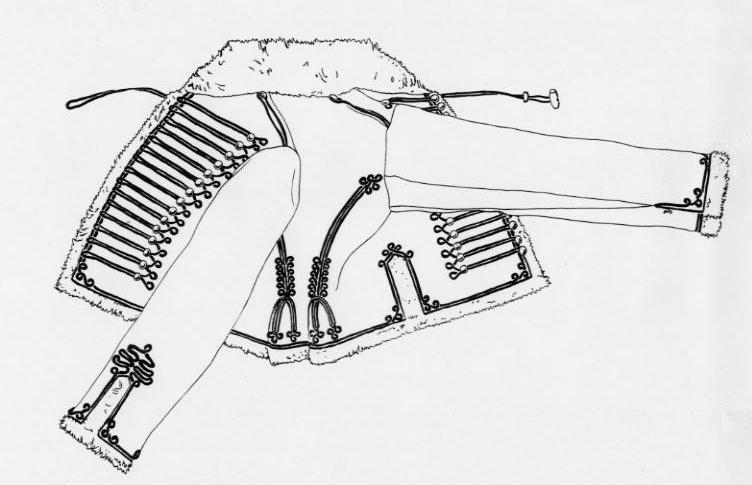
Private’s pelisse, Pavlograd Hussar Regiment,
1809-1812. From Valkovich’s depiction of an actual item in the Russian
State Historical Museum.
(Larger view.)
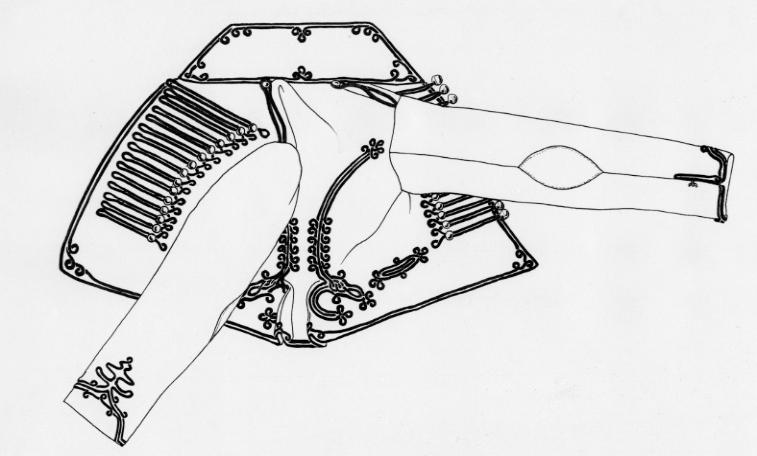
Private’s doman, Pavlograd Hussar Regiment,
1809-1812. From Valkovich’s depiction of an actual item in the Russian
State Historical Museum.
(Larger view.)
__________________
(1) Complete Collection of Laws of the Russian Empire [Polnoe Sobranie Zakonov Russiiskoi Imperii, hereafter PSZ — M.C.], Vol. XXVI, pg. 609, No 19,826.
(2) Archive of the Inspectorate Department of the War Ministry, in the book Ukases of the Government Military College for the year 1801.
(3) PSZ, Vol. XLIV, Pt. II, Section Four, Orders regarding uniforms, pg. 45, No 20,164.
(4) Ibid., pg. 45, No 20,186, and pg. 29, No 20,109.
(5) HIGHESTconfirmed table of uniform, accouterment, and weaponry items for a Cuirassier regiment, 30 April, 1802.
(6) PSZ, Vo. XLIV, Pt. II, in the Orders regarding uniforms, on pg. 74, line 12 from the bottom, as well as in the printed copies, distributed to the forces, of the regulations for clothing Cuirassiers at that time, it is stated that galloon is sewn on the upper edge, but according to all other sources, the testimony of contemporaries, and drawings preserved from that time, it is apparent that it was sewn on the lower edge, which was continued until 4 April, 1809.
(7) Everything stated here about clothing, weapons, and horse furniture for combatant and noncombatant ranks in Cuirassier regiments is based on: HIGHEST confirmed table of 30 April, 1802; rules located in PSZ, Vol. XLIV, Pt. II, Sect. IV, Orders regarding uniforms, pgs. 45-50, No 20,186, and pg. 29, No 20,109; drawings preserved in the SOVEREIGN EMPEROR’S Own Library in the Winter Palace, No 246 in the catalog; original articles preserved in various Arsenals, and the oral testimony of contemporaries.
(8) PSZ, Vol. XLIV, Pt. II, pg. 48, No 20,186.
(9) Ibid., Vol. XXVI, pg. 934, NoNo 20,989 and 21, 191; drawings in the SOVEREIGN EMPEROR’S Own Library, No 361 in the catalog; actual helmets preserved in Arsenals; HIGHEST confirmed table of uniform, accouterment, and weaponry items of the Replacement half-squadron with a Cuirassier regiment, 17 December, 1803, and evidence from contemporaries.
(10) Evidence from contemporaries.
(11) PSZ, Vol. XXVIII, pg. 887, No21,651.
(12) Ibid., Vol. XLIV, Orders regarding uniforms, pg. 31, No 22,197.
(13) Information received from the Commissariat Department of the War Ministry.
(14) PSZ, Vol. XXIX, pg. 21, No 22,382.
(15) Ibid., Vol. XLIV, pg. 14, No 22,625.
(16) Evidence from contemporaries.
(17) PSZ, Vol. XXX, pg. 45, No 22,784.
(18) Information received from the Commissariat Department of the War Ministry.
(19) PSZ, Vol. XLIV, pg. 13, No 23,373; actual helmets preserved in Arsenals; drawings from that time and evidence from contemporaries.
(20) Evidence from contemporaries.
(21) PSZ, Vol. XXX, pg. 781, No 23,478, and model clothing preserved in the Commissariat Department of the War Ministry.
(22) HIGHEST directive declared to the Military College by the Minister of Military Land Forces.
(23) Information received from the Commissariat Department of the War Ministry, where there are also kept models of contemporary cuirassier clothing.
(24) PSZ, Vol. XXX, pg. 1006, No 23,695.
(25) Ibid., pg. 1096, No 23,690.
(26) Model shabrack, with pistol holster covers, preserved in the Commissariat Department of the War Ministry.
(27) PSZ, Vol. XXXI, pg. 215, No 24,263
(28) Evidence from contemporaries.
(29) PSZ, Vol. XLIV, Pt. II, pg. 54, No 24,774.
(30) Ibid., pg. 69, No 24,769, and evidence from contemporaries.
(31) Announcement of the Minister of War to His Imperial Highness the Tsesarevich Constantine Pavlovich, 12 October, 1811, No 2588.
(32) PSZ, Vol. XXXI, pg. 910, No 24,899.
(33) Ibid., Vol. XLIV, Pt. II, pg. 31, NoNo24,911 and 24,912, and evidence from contemporaries.
(34) Evidence from contemporaries; contemporary portraits and drawings, and actual articles preserved in various Arsenals or held by private individuals.
(35) Archive of the Inspection Department of the War Ministry, in the book Ukases of the Government Military College for the year 1812, pg. 133.
(36) PSZ, Vol. XXXII, pg. 454, No 25,262.
(37) Ibid., Vol. XLIV, pg. 50, No 25,278, and model items kept by the Commissariat Department of the War Ministry.
(38) Ibid., No 25,292.
(39) Ibid.
(40) Ibid.
(41) Information received from the Inspection Department of the War Ministry.
(42) Information received from the Commissariat Department of the War Ministry.
(43) PSZ, Vol. XLIV, pg. 100, No 25,361.
(44) Ibid., pg. 133, No 25,463.
(45) Ibid., No 25,489, and evidence from contemporaries.
(46) Ibid., No 25,565.
(47) Ibid., No 25,589.
(48) Evidence from contemporaries.
(49) Ibid., Vol. XXXII, pg. 876, No 25,644, and evidence from contemporaries.
(50) Information received from the Artillery Department of the War Ministry, and evidence from contemporaries.
(51) Information received from the Inspection Department of the War Ministry.
(52) PSZ, Vol. XXXIII, pg. 1029, No 26,441.
(53) HIGHEST Order, and evidence from contemporaries.
(54) Model chin scales preserved at the Commissariat Department of the War Ministry.
(55) Evidence from contemporaries, and cuirasses preserved up to now in various Arsenals.
(56) Order of the Chief of the Main Staff of HIS IMPERIAL MAJESTY, 17 April, 1821, No 13.
(57) Order to the Cavalry of the Separate Corps of Military Settlements, 25 July, 1821, No 185.
(58) Information received from the THE HEIR AND TSESAREVICH’S Life-Cuirassier Regiment, 26 October, 1842, No 1278.
(59) PSZ, Vol. XL, pg. 188, No 30,309.
(60) HIGHEST Ukases announced by General-Adjutant Graf Liven to: the Vice-President of the Government Military College, General of Infantry Lamb — 1 April, and the Military College — 3 April, 1801. See also the entries for 29 May, 1798, and 3 April, 1800, in Volume VIII of Historical Description of the Clothing and Weapons of the Russian Forces, in the description of dragoon uniforms.
(61) Ibid.
(62) Ibid.
(63) Ibid.
(64) Ibid.
(65) Ibid.
(66) Ibid.
(67) Ibid.
(68) PSZ, Vol. XXIV, pg. 609, No 19,826.
(69) Ibid., Vol. XLIV, pg. 45, No 20,109.
(70) Ibid., pg. 51, No 20,186, and pg. 29, No 20,109.
(71) Everything stated here about clothing, weapons, and horse furniture for combatant and noncombatant ranks in Dragoon regiments is based on: HIGHEST confirmed table of 30 April, 1802; rules located cited in the foregoing Notes; drawings preserved in the SOVEREIGN EMPEROR’S Own Library in the Winter Palace, No 246 in the catalog; original articles preserved in various Arsenals, and the evidence of contemporaries. In regard to the sabers mentioned as part of the uniforms and weaponry of Dragoon regiments, information was received from the Artillery Department, and in addition based on the proposals of the Intendant-General of the Army to the Commissariat Commission, from 16 June and 4 July, 1802.
(72) PSZ, Vol. XLIV, pg. 52, No 20,186.
(73) Announcement by the Government Military College to the Commissariat Commission, 22 June, 1803.
(74) PSZ, Vol. XXVII, pg. 934, No 20,9989, and the same sources cited above in Note 9.
(75) Evidence from contemporaries, and actual hats from that time, preserved up to now in various Arsenals, including His Imperial Highness’s Own Arsenal in St. Petersburg.
(76) PSZ, Vol. XXVIII, pg. 53, No 21,651.
(77) Ibid., Vol. XLIV, pg. 53, No 23,205.
(78) Ibid., No 22,185.
(79) Ibid., pg. 31, No 22,197.
(80) Information received from the Commissariat Department of the War Ministry.
(81) PSZ, Vol. XXIX, pg. 201, No 22,382.
(82) Ibid., Vol. XLIV, pg. 53, No 22,398.
(83) Information received from the Artillery and Commissariat Departments of the War Ministry; broadswords preserved in various Arsenals, including the one in St. Petersburg, and engraved illustrations of the uniform clothing and weapons of Dragoon regiments, in the SOVEREIGN EMPEROR’SOwn Library, catalog No 1.
(84) PSZ, Vol. XLIV, pg. 14, No 22,625.
(85) Evidence from contemporaries.
(86) PSZ, Vol. XLIV, pg. 54, No 22,877.
(87) Ibid., Vol. XXX, pg. 45, No 22,784.
(88) Ibid., Vol. XLIV, pg. 54, No 29,215.
(89) Information received from the Commissariat Department of the War Ministry.
(90) Evidence from contemporaries.
(91) PSZ, Vol. XLIV, pg. 54, No 29,378; the illustrations cited in Note 83; helmets preserved in various Arsenals, and evidence from contemporaries.
(92) PSZ, Vol. XXX, pg. 781, No 23,478, and model items of clothing kept by the Commissariat Department of the War Ministry.
(93) Information received from the Commissariat Department of the War Ministry. In general, models and illustrations of dragoon uniform items are preserved from that time: the first at the Commissariat Department of the War Ministry, and the second are cited above in Note 83.
(94) PSZ, Vol. XXX, pg. 950, No 23,625. See also this article in the preceding volume, under the description of uniforms and weapons for Grenadier regiments.
(95) PSZ, Vol. XXX, pg. 1006, No 23,695.
(96) Ibid., pg. 1096, No 23,790.
(97) Information received from the Commissariat Department of the War Ministry.
(98) PSZ, Vol. XXXI,pg. 215, No 24,263.
(99) Evidence from contemporaries.
(100) PSZ, Vol. XLIV, pg. 54, No 24,774.
(101) Information received from the Commissariat Department of the War Ministry.
(102) PSZ, Vol. XLIV, pg. 54, No 24,866.
(103) Ibid., Vol. XXXI, pg. 910, No 24,899.
(104) Ibid., Vol. XLIV, pg. 31, NoNo 24,911 and 24,912, and information received from the Commissariat Department of the War Ministry.
(105) Archive of the Inspection Department of the War Ministry, in the book Ukazy of the Military College for 1812, pg. 133.
(106) Evidence from contemporaries, and information received from the Commissariat Department of the War Ministry.
(107) PSZ, Vol. XXXII, pg. 454, No 25,262.
(108) Ibid., Vol. XLIV, pg. 50, No 25,278.
(109) Information received from the Commissariat Department of the War Ministry.
(110) Ibid.
(111) Ibid.
(112) HIGHEST Order.
(113) Information received from the Artillery Department of the War Ministry.
(114) Information received from the Commissariat Department of the War Ministry, and evidence from contemporaries.
(115) Ibid.
(116) Ibid.
(117) PSZ, Vol. XLIV, pg. 134, No 26,111.
(118) Ibid., XXXIII, pg. 1026, No 26,436, and information received from the Commissariat Department of the War Ministry.
(119) Ibid., Vol. XLIV, pg. 101, No 26,727, and actual cartridge pouches preserved from that time.
(120) Ibid., sg. 134, No 26,728; actual models preserved by the Commissariat Department of the War Ministry; information received from this Department; engravings of Dragoons from that time, by Captain Kiel, now Major General of HIS IMPERIAL MAJESTY’S Suite, and evidence from contemporaries. See also the Collection of Laws and Directives Relating to the Military Administration, for 1817, book I, pg. 211.
[Ludwig Kiel (in Russian, Lev Ivanovich Kil) — At first he was an adjutant to Grand Duke Constantine Pavlovich, and then transferred to His Majesty’s Suite. He painted watercolors and drew portraits on stone (for lithography), and then from 1815 to 1819 he engraved costumes of the Russian army at the request of Grand Duke Nicholas Pavlovich (later Tsar Nicholas I). At the end of the 1840’s he lived in Rome and was the leader of the Russian artists’ community there; he was an honorary corresponding member of the Academy of Artists. Died in Paris in November, 1851. Source: Russian Biographical Dictionary. - M.C.]
(121) See above, in the text for this volume, the entry for 1 February, 1816.
(122) PSZ, Vol. XLIV, pg. 101, No 26,727.
(123) Ibid., pg. 138, No 26,801.
(124) Information received from the Commissariat Department of the War Ministry.
(125) PSZ, Vol. XLIV, pg. 101, No 27,681.
(126) Ibid., pg. 134, No 28,153, and pompons preserved as artifacts and in drawings.
(127) Order of the the Chief of HIS IMPERIAL MAJESTYS Main Staff, 8 April, 1840 [sic, should be 18 April, 1820 - M.C.], No 21.
(128) PSZ, Vol. XXXVII, pg. 409, No 28,347.
(129) Ibid., Vol. XL, pg. 188, No 30,309.
(130) Evidence from contemporaries.
(131) PSZ, Vol. XLIV, pg. 58, No 25,292.
(132) Information received from the Commissariat and Artillery Departments of the War Ministry, and evidence from contemporaries.
(133) Ibid.
(134) Ibid.
(135) Ibid.
(136) PSZ, Vol. XLIV, pg. 58, No 25,292.
(137) Ibid., pg. 102, No 25,611, and model articles.
(138) Information received from the Commissariat Department of the War Ministry.
(139) HIGHEST Order and information received from this same Department.
(140) Information received from this same Department, and evidence from contemporaries.
(141) Information received from this same Department, and model horse-jäger uniform items preserved there. See also the illustrations of Maj. Gen. Kiel mentioned in Note 120.
(142) PSZ, Vol. XLIV, pg. 134, No 26,111.
(143) Information received from the Commissariat Department of the War Ministry.
(144) Ibid.
(145) PSZ, Vol. XXXIII, pg. 1026, No 26,434.
(146) Ibid., Vol. XLIV, pg. 136, No 26,722.
(147) Information received from the Commissariat Department of the War Ministry.
(148) PSZ, Vol. XLIV, pg. 138, No 26,801.
(149) Information received from the Commissariat Department of the War Ministry.
(150) Information received from the Artillery Department of the War Ministry, and actual horse-jäger sabers and muskets from that time. See also Description of the Tula Arms Factory, by G. Gamel, Moscow, 1826, pg. 442 and Table III.
(151) PSZ, Vol. XLIV, pg. 101, No 27,681.
(152) Information received from the Commissariat Department of the War Ministry.
(153) PSZ, Vol. XLIV, pg. 134, No 28,153.
(154) Order of the Chief of HIS IMPERIAL MAJESTY’S Main Staff, 18 April, 1820, No21.
(155) PSZ, Vol. XL, pg. 188, No 30,309.
(156) Evidence from contemporaries.
(157) Everything stated here about clothing, weapons, and horse furniture for combatant and noncombatant ranks in Hussar regiments is based on: HIGHEST confirmed table of 30 April, 1802; descriptions in PSZ, Vol. XLIV, pg. 55, No 20,279, and pg. 29, No 20,109; information received from the Commissariat Department of the War Ministry; the drawings mentioned above in Note 71, and evidence from contemporaries.
(158) Ibid.
(159) PSZ, Vol. XL, pg. 188, No 30,309. information received from the Commissariat Department of the War Ministry; drawings in the SOVEREIGN EMPEROR’S Own Library, catalog No 361; actual items preserved in various Arsenals and at the Commissariat Department of the War Ministry, and evidence from contemporaries.
(160) Announcement from the Military College to the Military Commission, 20 August, 1803; information from the Commissariat Department of the War Ministry, and .
(161) PSZ, Vol. XLIV, pg. 56, No 20,972.
(162) Evidence from contemporaries.
(163) PSZ, Vol. XLIV, pg. 56, No 22,185.
(164) Ibid., pg. 31, No 22,197.
(165) Information from the Commissariat Department of the War Ministry.
(166) HIGHEST Directive announced to the Military College by the Minister of Military Land Forces, 2 December, 1806.
(167) PSZ, Vol. XLIV, pg. 56, No 22,491.
(168) Ibid., No 22,692.
(169) Ibid., No 22,693.
(170) Information from the Commissariat Department of the War Ministry.
(171) PSZ, Vol. XLIV, pg. 57, No 23,470.
(172) Ibid., Vol. XXX. pg. 781, No 23,478.
(173) Ibid., pg. 1006, No 23,695.
(174) Ibid., pg. 1219, No 23,919.
(175) Ibid., Vol. XLIV, pg. 57, No 23,470; information received from the Artillery and Commissariat Departments of the War Ministry; actual items of Hussar uniforms and weaponry from that time, preserved in His Imperial Highness the Grand Duke Michael Pavlovich’s Own Arsenal and at the Commissariat Department, and evidence from contemporaries.
(176) PSZ, Vol. XXXI, pg. 215, No 24,263.
(177) Evidence from contemporaries.
(178) Information received from the Commissariat Department of the War Ministry.
(179) PSZ, Vol. XLIV, pg. 31 NoNo 24,911 and 24,912, and evidence from contemporaries.
(180) Information received from the Commissariat Department of the War Ministry; evidence from contemporaries, and contemporary portraits and drawings.
(181) PSZ, Vol. XXXII, pg. 454, No 25,262.
(182) Ibid., Vol. XLIV, pg. 57, No 25,278.
(183) Ibid., pg. 57, No 25,292; see the text in the entry for 13 April, 1821.
(184) HIGHEST Order and information received from the Commissariat Department of the War Ministry.
(185) PSZ, Vol. XLIV, pg. 133, No 25,565.
(186) HIGHEST Order and information received from the Commissariat Department of the War Ministry.
(187) Information received from the Commissariat Department of the War Ministry, and evidence from conteporaries.
(188) Ibid.
(189) Information received from the Commissariat Department of the War Ministry; evidence from conteporaries, and contemporary drawings, including those mentioned above in Note 120.
(190) HIGHEST Order; information received from the Commissariat Department of the War Ministry, and evidence from contemporaries.
(191) PSZ, Vol. XLIV, pg. 138, No 26,801.
(192) Information received from the Commissariat Department of the War Ministry, and contemporary drawings.
(193) PSZ, Vol. XLIV, pg. 134, No 27,079.
(194) Description of the Tula Arms Factory, cited in Note 150.
(195) Information received from the Commissariat and Artillery Departments of the War Ministry.
(196) Information received from the Commissariat Department of the War Ministry, where models of hussar uniform items from that time are preserved, and evidence from contemporaries.
(197) Ibid.
(198) PSZ, Vol. XLIV, pg. 101, No 27,681.
(199) Ibid., pg. 134, No 28,153.
(200) Order of the Chief of HIS IMPERIAL MAJESTY’S Main Staff, 18 April, 1820, No21.
(201) The kind of order, from 13 April, 1821, No 11.
(202) PSZ, Vol. XL, pg. 188, No 30,309.
(203) Evidence from contemporaries.
(204) Information about the uniforms and weapons of these two regiments—the Tatar-Lithuanian and Polish—is taken from contemporary documentation on items of their uniform clothing, accouterments, and weaponry. Also used as sources were drawings preserved in the SOVEREIGN EMPEROR’S Own Library, catalog No246, sheets 35 and 36.
(205) Ibid.
(206) PSZ, Vol. XXVII, No 20,694, pg. 521.
(207) Ibid., Vol. XLIII, Part II, continuation of the first section, pg. 17, No 20,695; HIGHEST confirmed table of uniform, accouterment, and weaponry items of the Tatar and Lithuanian Horse Regiments, 30 March, 1803; actual shapka headdresses preserved in the SOVEREIGN EMPEROR’SOwn Arsenal; information received from the Commissariat Department of the War Ministry, and evidence from contemporaries.
(208) The same volume of PSZ and the same table mentioned in the preceding note.
(209) HIGHEST confirmed table of uniform, accouterment, and weaponry items for a Lancer regiment, 26 September 1803: actual articles preserved in Arsenals and at the Commissariat Department of the War Ministry; information received from this Department, and evidence of contemporaries.
(210) Ibid.
(211) Ibid.
(212) HIGHEST confirmed table of uniform, accouterment, and weaponry items for the Polish Horse Regiment, 20 March 1805.
(213) Proposal of the Intendant-General of the Army to the Commissariat Office, 26 February 1806, and information received from the Commissariat Department of the War Ministry.
(214) Proposal of the Intendant-General of the Army to the Commissariat Office, 2 May,1806, and information received from the Commissariat Department of the War Ministry.
(215) Information received from the same Department.
(216) PSZ, Vol. XXIX, pg. 901, No 22,382.
(217) PSZ, Vol. XXIX, No 22,526, pg. 1184, and information received from the Commissariat Department of the War Ministry.
(218) Information received from the Commissariat Department of the War Ministry.
(219) Ibid.
(220) Ibid.
(221) PSZ, Vol. XLIV, Part II, Fourth Sect., in Ukases Regarding Uniforms, pg. 57, No 23,205; actual items kept in Arsenals and by the Commissariat Department of the War Ministry; information received from this Department, and evidence from contemporaries.
(222) PSZ, Vol. XXX, No 23,232, pg. 530, and information received from the Commissariat Department of the War Ministry.
(223) PSZ, Vol. XXX, pg. 781, No 23,478, and information received from the Commissariat Department of the War Ministry.
(224) Information received from the Commissariat Department of the War Ministry.
(225) PSZ, Vol. XLIV, pg. 57, No 24,883.
(226) Ibid., pg. 31, NoNo 24,911 and 24,912, and evidence from contemporaries.
(227) Ibid., pg. 50, No 25,278, and information received from the Commissariat Department of the War Ministry.
(228) Information received from this Department; actual items from this time, preserved at this Department and various Arsenals; contemporary portraits and drawings, and evidence from contemporaries.
(229) PSZ, Vol. XLIV, pg. 58, No 25,242, and information received from the Commissariat Department of the War Ministry.
(230) Information received from this same Department.
(231) Ibid.
(232) PSZ, Vol. XLIV, pg. 102, No 26,018, and information received from the Commissariat Department of the War Ministry.
(233) Information received from this same Department, and the same volume of PSZ, pg. 120, No 25,644.
(234) PSZ, Vol. XLIV, pg. 102, No 26,018, and pg. 135, No 26,019.
(235) Information received from the Commissariat Department of the War Ministry.
(236) Ibid.
(237) Information received from this same source, and PSZ, Vol. XXXIV, pg. 794, No27,081.
(238) Information received from the Commissariat Department of the War Ministry.
(239) Information received from this same Department, and PSZ, Vol. XLIV, pg. 137, No 27,392.
(240) Information received from the Commissariat Department of the War Ministry.
(241) PSZ, Vol. XLIV, pg. 101, No 27,260.
(242) Evidence from contemporaries.
(243) Information received from the Commissariat Department of the War Ministry.
(244) PSZ, Vol. XLIV, pg. 135, No 27,899; pg. 136, NoNo 27,900 and 28,183, and model items preserved in the Commissariat Department of the War Ministry.
(245) PSZ, Vol. XLIV, pg. 136, No 27, 984.
(246) Ibid., No 28,355, a) .
(247) Model uniforms from this year, kept at the Commissariat Department of the War Ministry, and information received from this Department.
(248) PSZ, Vol. XL, pg. 188, No 30,309.
(249) Order to the Army, by the Commander-in-Chief, General-Field Marshal Barclay de Tolly, 10 June 1815.
(250) Information received from the Commissariat Department of the War Ministry.
(251) Ibid.
(252) Information received from the same source; Order of the Chief of HIS IMPERIAL MAJESTY’S Main Staff, 15 May,1817, No 45, and engravings by Maj. Gen. Kiel, mentioned above in Note 120.
(253) Information received from the same Department, and the model items themselves, preserved here.
(254) PSZ, Vol. XL, pg. 188, No 30,309.
(255) Model uniform clothing, preserved at the Commissariat Department of the War Ministry, and the Archive of the Inspection Department of this same Ministry, in the file regarding the formation of Train battalions for the Independent Lithuania Corps, 1820, No 430, sheet 107.
(256) PSZ, Vol. XLIV, pg. 139, No 27,955.
(257) Information received from the Commissariat Department of the War Ministry, and the file cited above in Note 255.
(258) Information received from this same Department.
(259) PSZ, Vol. XLIV, pg. 139, No 28,429.
(260) Order of the Chief of HIS IMPERIAL MAJESTY’S Main Staff, 6 January, 1821, No1.
(261) PSZ, Vol. XLIV, pg. 139, No 28,969.
(262) Ibid., pg. 137, No 29,256.
(263) Ibid., No 30,325, and information received from the Commissariat Department of the War Ministry.
(264) Ibid., Vol. XL, pg. 188, No 30,309.
END OF NOTES TO VOLUME ELEVEN.